Plain answer
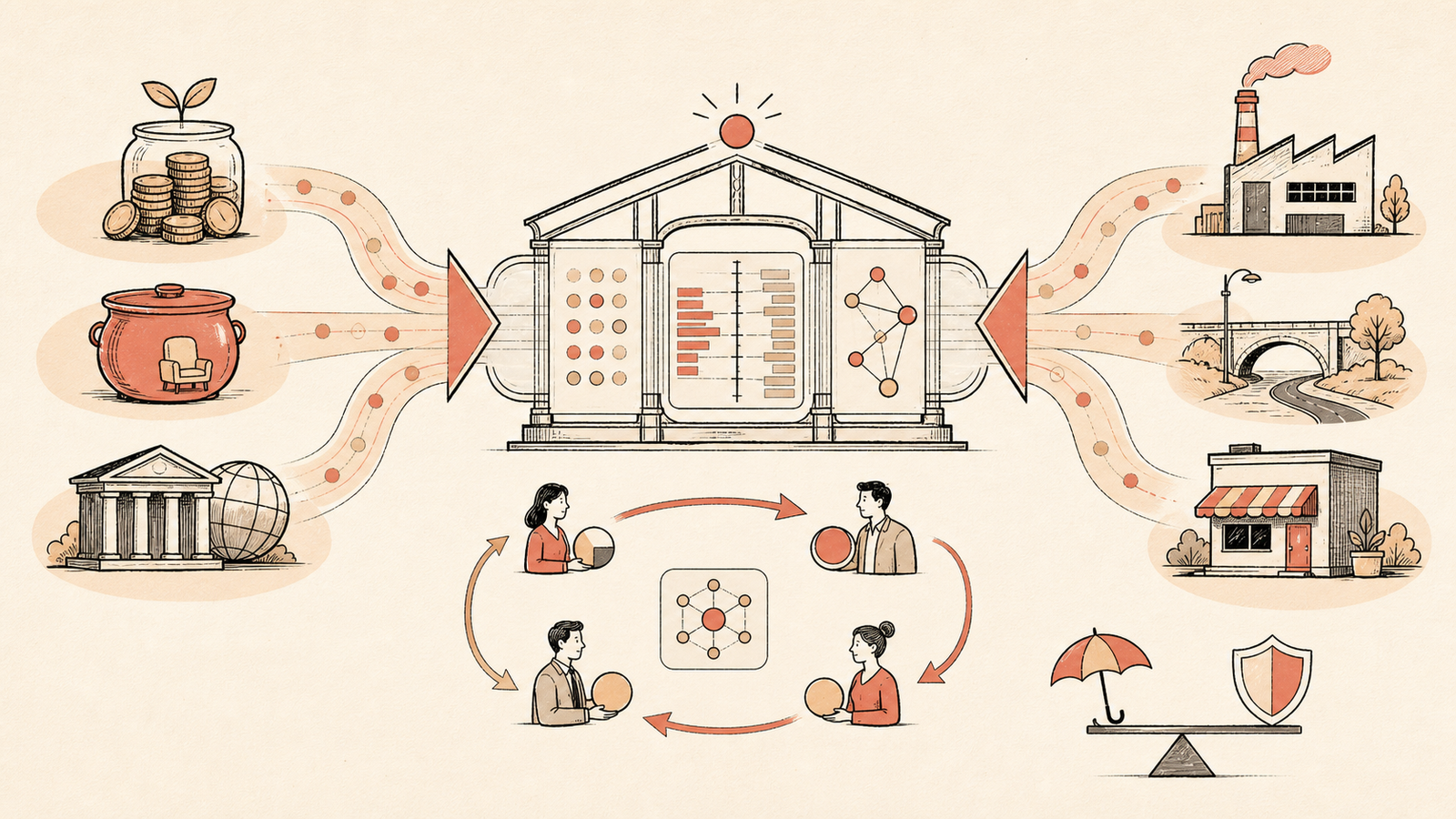
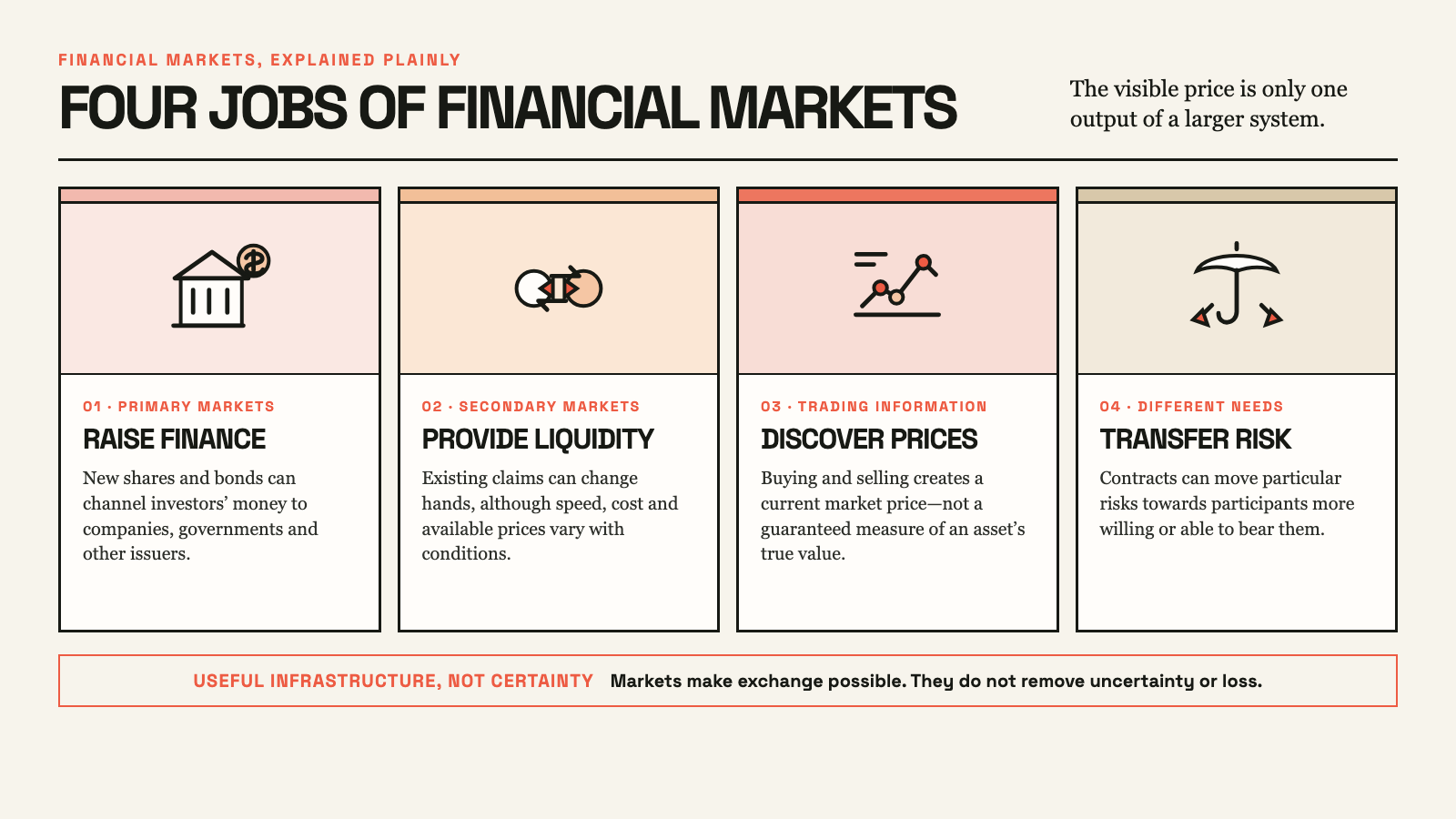
Financial markets exist to move money from people and institutions that can invest it to businesses, governments and others that can use it, while giving investors a way to trade those financial claims. They also help discover prices, provide liquidity and transfer risk, although none of those functions works perfectly all the time.
When financial news says “the markets rose” or “investors sold off”, it can sound as if markets are giant scoreboards whose purpose is to produce changing numbers. Prices do matter, but they are the visible output of a more useful system.
A business may need money today to build a factory. A government may want to spread the cost of infrastructure. A pension fund needs assets for future payments. An exporter may want protection against exchange-rate movements. Financial markets help these different needs meet.
The simplest way to understand them is to separate two activities. The first is raising finance: creating and selling a financial claim, such as a share or bond. The second is trading an existing claim between investors. Together, these activities help money move, give investments a price and allow financial risk to be shared.
What counts as a financial market?
A financial market is a system in which financial assets or contracts are issued or traded. It may be an electronic exchange, a network of banks and dealers, or another organised arrangement.
The stock market is one example, but it is not the whole system. Important financial markets include:
- share or equity markets, where ownership stakes in companies are issued and traded;
- bond markets, where governments, companies and other bodies borrow by issuing tradable IOUs;
- money markets, which provide short-term borrowing and lending;
- foreign-exchange markets, where one currency is exchanged for another; and
- derivatives markets, where contracts derive their value from something else, such as a share price, interest rate, currency or commodity.
Some trading happens on regulated exchanges; some happens away from exchanges, often through dealer networks. These markets bring together parties with different needs and turn those needs into financial transactions.
1. Financial markets help useful projects obtain money
The first job is often called capital formation. In plain English, that means turning savings into funding for investment.
Suppose a growing company wants £50 million to build a factory. The figure is illustrative, not a real fundraising proposal. The company could borrow from a bank, retain profits, seek private investors, issue bonds or sell shares. A public share issue is one possible route: many investors can each provide part of the required sum in exchange for part-ownership of the company.
A share represents an ownership interest. A bond is different: it is a form of borrowing, under which the issuer promises payments on stated terms. Both can help an organisation raise money, but they give the investor different claims and expose both sides to different risks.
The market in which a newly created security is sold is the primary market. Money paid for newly issued shares or bonds goes to the issuer, after costs.
Capital formation does not guarantee that money will be used well. A factory can fail and a government project can run over budget. Markets provide a way to assess and fund proposals; they do not remove risk. Investors seek a return because they accept uncertainty and possible loss.
Purpose: distinguish money raised for an issuer from later trading between investors.
Picture it: primary and secondary markets
| Feature | Primary market | Secondary market |
|---|---|---|
| What is traded? | A newly issued share, bond or other security | A security that already exists |
| Typical seller | The company, government or other issuer | An existing investor |
| Who usually receives the purchase money? | The issuer, after transaction costs | The selling investor, after transaction costs |
| Main purpose | Raise new finance | Allow ownership to change and establish a current market price |
| Simple example | A company sells new shares in a public offering | One investor later sells those shares to another |
A primary-market purchase funds the issuer; a secondary-market purchase normally pays the investor who is selling.
Text equivalent: primary markets sell newly created securities to raise finance for an issuer. Secondary markets trade existing securities between investors, allowing ownership to change and helping establish a current price.
This distinction prevents a common misunderstanding. When you buy an existing share on a stock exchange, your money normally goes to the investor selling it, not directly to the company. The trade still matters to the wider funding system, but it is not itself a fresh injection of capital into that business.
2. Secondary markets make long-term claims easier to hold
Why would an investor commit money to a long-term business or a 20-year bond? One reason is the possibility of selling the investment before the company is wound up or the bond matures.
That is the role of the secondary market, where existing securities change hands. It can provide liquidity: the ability to buy or sell an asset reasonably quickly, at a cost and without causing an unusually large movement in its price.
Liquidity is not a yes-or-no property. Shares in a large, frequently traded company may normally be easier to sell than shares in a tiny company with few willing buyers. Even a usually liquid market can become difficult during a crisis. The price available for an immediate sale may also be lower than the last quoted price, particularly for a large order or a thinly traded asset.
This qualification matters. “Listed” does not mean “guaranteed to sell instantly at the price you want”. A market creates an opportunity to trade; it cannot promise that another participant will accept your terms.
Even so, the possibility of resale makes financial claims more attractive. An investor may be more willing to provide money in the primary market if there is a workable secondary market later. Everyday trading can therefore support future fundraising even when the company receives no cash from each trade.
3. Trading helps discover a price
The third job is price discovery: the process through which buying and selling produce a market price.
Buyers submit prices they are willing to pay; sellers state prices they are willing to accept. Trading systems match compatible orders, or dealers quote prices at which they are prepared to transact. Completed trades and current bids and offers provide information about what market participants will pay at that moment.
Those decisions reflect many inputs: company results, expected profits, interest rates, inflation, political events, risk appetite and the alternatives available to investors. New information can change those judgements and therefore the price.
No single person normally decrees the continuously traded price of a widely held public share. But that does not mean every market is perfectly competitive or equally transparent. Large participants can influence prices, some assets trade rarely, and different venues use different mechanisms. In some markets, the most visible price may come from a small number of recent transactions.
Most importantly, price is not the same as true value. A market price is the level at which participants can trade now. Poor information, forced selling, optimism, fear or limited liquidity can distort it. Price discovery is a continuing process, not a machine that produces a final correct answer.
Still, an imperfect public price is useful. It gives investors a reference point, helps companies judge the terms on which they might raise more money and allows gains and losses to be measured. Without a workable price-discovery process, valuing assets and agreeing transactions would be slower, costlier and more dependent on private negotiation.
4. Markets help move risk to people willing to bear it
Finance is not only about raising cash. Businesses and investors also face risks they may want to reduce or reshape.
Consider a UK business that knows it will receive US dollars in three months. If the dollar weakens against sterling before payment arrives, those dollars will be worth fewer pounds. A foreign-exchange contract can allow the business to fix or otherwise manage the exchange rate in advance. The example is illustrative: it shows how a market can transfer currency risk, not that hedging is always necessary or profitable.
Derivatives such as futures and options can be used to manage movements in currencies, interest rates, commodities and asset prices. The party reducing one risk needs a counterparty willing to take the other side, perhaps because that counterparty has a different exposure or is deliberately seeking the risk.
Risk transfer does not make risk disappear. A hedge can be incomplete, expensive or poorly designed. Derivatives can also be used for speculation and may magnify losses when leverage is involved. The useful economic function is that a market can move a particular risk towards participants more willing or able to bear it, provided the contract and the counterparty perform as expected.
5. Rules and infrastructure make exchange more dependable
A functioning market needs more than buyers and sellers. It also needs agreed contracts, trading rules, systems for recording ownership, arrangements for completing trades and ways to address misconduct or failure.
In the UK, the London Stock Exchange operates trading venues, including its Main Market, and provides technology that matches buyers and sellers. The Financial Conduct Authority, or FCA, is the conduct regulator and the UK listing authority. Different markets and securities fall under different rulebooks, so it would be misleading to treat every financial market as if it had one identical set of protections.
Disclosure is part of that framework. UK market-abuse rules generally require affected issuers to disclose inside information that directly concerns them as soon as possible, although permitted delays and other conditions can apply. These rules aim to make relevant information available and support market integrity.
They do not give every investor perfect knowledge. Regulation can reduce information gaps and set consequences for misconduct; it cannot eliminate uncertainty or guarantee fair outcomes in every trade.
The plumbing matters too. Clearing is the process of calculating what each party owes after a trade. Settlement is the exchange of the asset and payment that completes it. Reliable infrastructure allows large numbers of strangers and institutions to transact without having to build a new system of trust for every deal.
6. Why secondary trading matters to the real economy
It is reasonable to ask whether constant trading helps a company build anything. Much of it simply transfers an existing asset from one investor to another.
The answer is indirect. A liquid secondary market can make investors more willing to buy new securities. Prices signal the return investors demand and therefore the terms on which issuers may be able to raise money. Share prices can affect the attractiveness of issuing new shares.
These signals are noisy. A rising share price does not prove that management is creating lasting value, and a falling price does not automatically prove the opposite. Trading can become detached from long-term business performance, particularly over short periods. But removing secondary trading would also remove much of the flexibility and price information that makes primary fundraising practical.
7. Financial markets can fail at their jobs
More trading is not always better. Markets can fund fashionable but weak projects. Prices can overshoot. Liquidity can vanish when many people sell together. Complexity and leverage can spread losses, while unequal access to information can damage trust.
There are also costs: fees, bid-offer spreads, compliance work, technology and the resources spent analysing and trading. Those costs should be weighed against the benefits of funding, liquidity, pricing and risk transfer.
This is why resilient institutions and proportionate regulation matter. Well-run markets support the economy; fragile or abusive markets can transmit harm to businesses, workers, savers and taxpayers. The existence of a quoted price should never be confused with the absence of risk.
Illustrative status: general education, not a recommendation to trade or invest.
What this means for an ordinary investor
You do not need to trade frequently to be affected by financial markets. Pension funds invest through them. Governments borrow through bond markets. Companies use them to raise finance and manage risk. Interest rates and market prices influence the returns available on savings and investments and, indirectly, some borrowing costs.
Understanding the market’s purpose also improves how you read financial news. A price move is the result of transactions made by participants with different time horizons, information and constraints, not an objective verdict from above.
That leads to five practical takeaways:
- Ask whether a transaction is primary or secondary. It tells you whether new money is reaching the issuer or an existing asset is changing hands.
- Treat liquidity as conditional. Check how easily an asset normally trades, what it may cost to exit and what could happen under stress.
- Read price as information, not truth. It is useful evidence of current supply and demand, not a guarantee of underlying value.
- Identify who bears the risk. Markets often transfer risk rather than remove it.
- Look for the rules and infrastructure. Venue, disclosure, clearing, settlement and regulation affect how dependable a market is.
Financial markets exist because funding, ownership, time and risk do not naturally line up. They provide systems for bringing those pieces together. Their value lies less in the daily drama of rising and falling prices than in enabling finance to be raised, claims to be traded, risks to be shared and decisions to be made using a common, if imperfect, price.