Plain answer
Investing usually means buying assets to pursue a long-term goal and judging them mainly by their underlying value and continued suitability. Trading means trying to benefit from shorter-term price movements, so entry timing, exit rules, position size and execution costs become central to every decision. Neither approach is automatically safe, but trading generally demands more frequent decisions and leaves less room for mistakes.
The same share can be an investment for one person and a trade for another. One buyer expects the business to grow over a decade and plans periodic reviews. Another expects the price to rise after next week’s results and plans to leave within days, whether the move is up or down.
They own the same asset, but they are making different bets. The investor’s case depends mainly on what the asset may produce or become over years. The trader’s case depends mainly on what its price may do within a defined window. That changes the research, the daily routine, the meaning of risk and the reasons for selling.

Purpose: compare the decision processes used for investing and trading before money is committed.
Trading vs investing at a glance
| Question | Investing | Trading |
|---|---|---|
| Main aim | Build wealth or income over years through ownership of assets | Seek gains from shorter-term price movements |
| Typical focus | The asset’s value, quality, income and long-term prospects | Price behaviour, catalysts, timing and market conditions |
| Holding period | Usually years | Often minutes, days, weeks or months |
| Buying decision | Is this asset suitable and reasonably valued for the goal? | Is there a defined set-up with an acceptable entry and risk? |
| Selling decision | Has the case, valuation, goal or desired portfolio balance changed? | Has the target, time limit or point that invalidates the trade been reached? |
| Risk control | Diversification, asset allocation, valuation and time horizon | Position size, exit rules, order choice and limits on losses |
| Work pattern | Upfront research, regular contributions and periodic review | Repeated screening, planning, execution, monitoring and record-keeping |
| Cost sensitivity | Costs matter, but transactions may be infrequent | Spreads, fees and imperfect execution recur more often |
The boundary is not a universal number of days. The clearest distinction is the decision process established before buying.
Text equivalent: investing generally centres on long-term ownership, suitability, value, diversification and periodic review. Trading generally centres on a shorter-term price opportunity, timing, position size, execution and defined exit rules. Both approaches involve uncertainty and costs.
This is a comparison of approaches, not a promise about outcomes. A concentrated investment in one fragile company can be riskier than a small, tightly controlled trade in a liquid market. Products involving leverage, such as contracts for difference, add another layer of risk, but leverage is not what defines trading and it is not considered in the examples below.
What an investor does in practice
An investor normally starts with a goal and a time horizon. The goal might be retirement, future income or simply long-term growth. The time horizon matters because money needed soon should not depend on an asset that may be difficult to sell or temporarily depressed at the wrong moment. The Financial Conduct Authority suggests treating investing as a long-term activity and uses at least five years as a useful general timeframe, while stressing that losses are still possible.
The next job is deciding what to own. For a fund investor, that may mean examining what the fund holds, how diversified it is, what it costs and whether its risk matches the goal. For someone selecting an individual company, it may involve the business model, finances, competitive position, management, valuation and threats to the original case. An investor can also study price, but price is considered in relation to long-term value rather than as a short-term signal on its own.
After buying, patience matters, but “buy and forget” is the wrong lesson. The investor should review periodically whether the holding still does the job for which it was bought. A review may ask whether the underlying case has changed, whether one holding has become too large, whether costs remain reasonable and whether the investor’s goal or circumstances are different. The FCA likewise recommends keeping on top of investments through periodic review.
What the investor usually tries to avoid is turning every market movement into a new decision. A daily fall does not necessarily say anything meaningful about a company’s prospects over ten years. Constant checking can tempt someone to abandon a sound plan because of discomfort rather than evidence. The point is not to ignore new information; it is to separate information that affects the long-term case from noise that merely moves today’s price.
An investor therefore needs rules, even if they are used less often. Reasons to sell might include a broken investment case, excessive valuation, rebalancing or an approaching financial goal. A falling price alone is not a complete reason; what matters is whether it reflects genuine deterioration or ordinary volatility the plan was designed to tolerate.
What a trader does in practice
A trader begins with a repeatable set-up rather than a general belief that an asset is “good”. The plan should identify the conditions being traded, the signal for entry, the evidence that would show the idea is wrong, the intended exit and the amount at risk. A promising idea is not a complete trade until its risk is defined.
This makes timing part of the decision. A trader can be broadly right about a company and still lose because the expected move happens too late, a short-term catalyst disappoints or the chosen entry leaves too little room for normal price movement. The trader must decide not only what might happen, but why it might happen within the intended period.
The exit deserves as much attention as the entry. Before committing money, a trader may define a profit target, a maximum holding period and an invalidation point: the price or event showing that the original set-up no longer holds. That does not guarantee a controlled outcome. It creates a decision rule before money and emotion are involved.
A stop-loss order is one possible execution tool, not a substitute for a risk plan. A standard sell stop is triggered when the specified stop price is reached and then normally becomes a market order. In a fast or thin market, the eventual sale may occur below the stop price. A brief price move can also trigger the order just before the market recovers. A stop-limit order gives more control over price, but may not execute at all. Order types and availability vary by market and broker, so a trader needs to understand the instructions actually being used.
After the position closes, a trading record can capture the entry reason, planned risk, execution, exit and result. A meaningful series of comparable trades can show whether the method worked after costs and whether the trader followed it. One memorable result proves little.
Position size turns an idea into a defined risk
Consider a purely illustrative share trade. A trader has a £10,000 trading account and decides, for this example only, that the most they intend to lose if the plan works as designed is £100. The proposed entry is £10 a share and the point that invalidates the idea is £9.50, a difference of 50p per share.
Dividing the intended £100 loss by the 50p risk per share gives 200 shares. At the £10 entry, the position has a nominal value of £2,000. The calculation is:
£100 intended account risk ÷ £0.50 planned risk per share = 200 shares
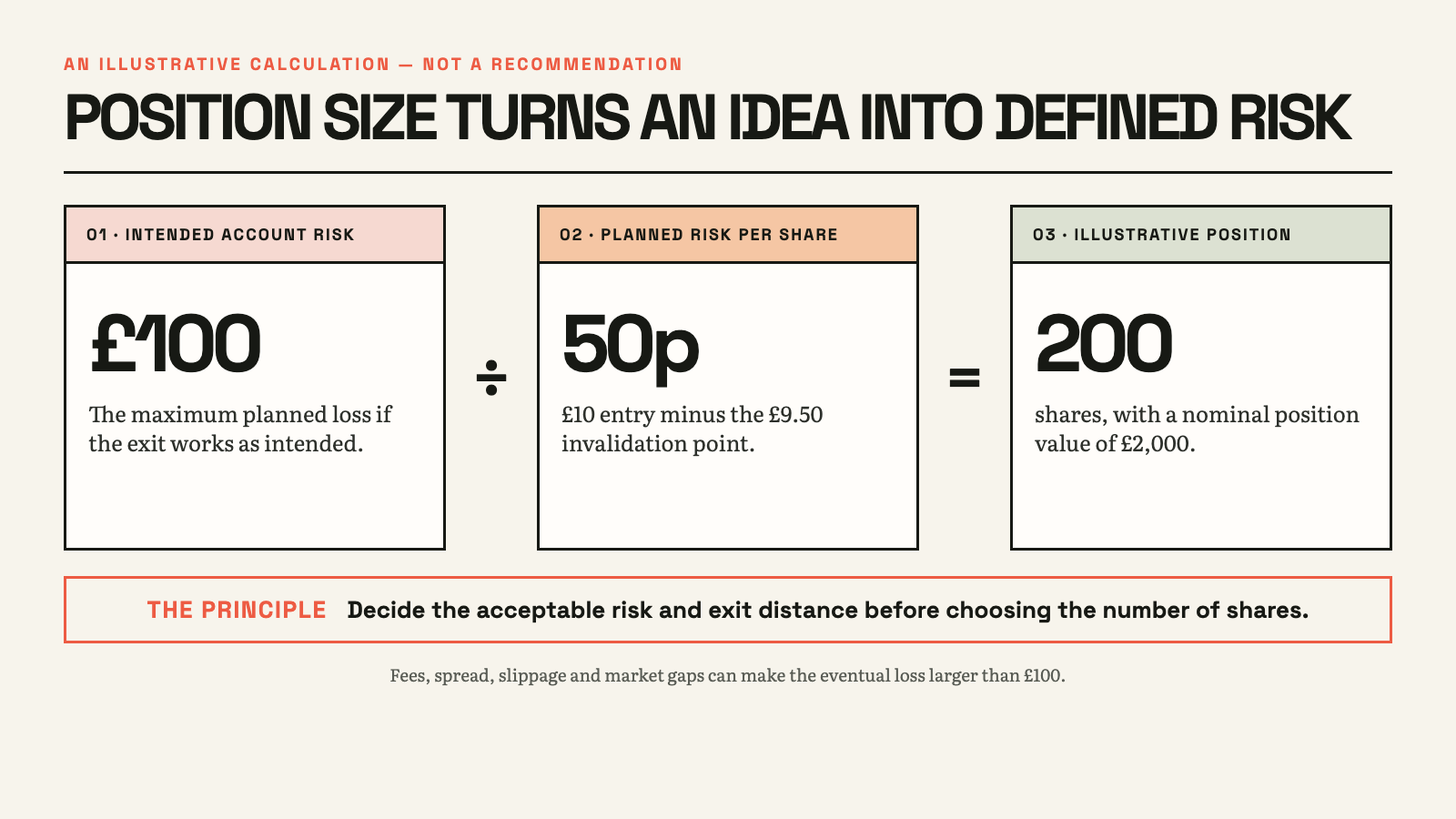
This example demonstrates how the distance between entry and planned exit affects position size. It does not show that risking £100 is suitable, that the stop is sensibly placed or that the trade has a profitable edge. It also excludes fees, the bid-offer spread and slippage, which is the difference between the expected execution price and the price actually received. If the market gaps below £9.50, the loss can exceed £100.
This is why position size and exit planning belong together. Choosing the number of shares first and thinking about the possible loss afterwards reverses the process. A small price movement on an oversized position can do more damage than a larger movement on a controlled one.
Repeated trading raises the cost hurdle
Buying and selling is not costless, even when a platform advertises zero commission. Costs can include dealing fees, platform charges, taxes, financing and foreign-exchange conversion. Tax and product-specific charges depend on the instrument and the reader’s circumstances and are not calculated here.
One cost built into a quoted market is the bid-offer spread. The bid is the highest quoted price a buyer is willing to pay; the offer is the lowest quoted price at which a seller is willing to sell. The difference is the spread. A person buying at the offer and immediately selling at the bid crosses that gap.
Suppose an illustrative share is quoted at a 99p bid and a 101p offer. Buying one share at 101p and immediately selling it at 99p produces a 2p loss, about 1.98% of the purchase price, before any other charge:
(101p purchase price − 99p sale price) ÷ 101p = 1.98%
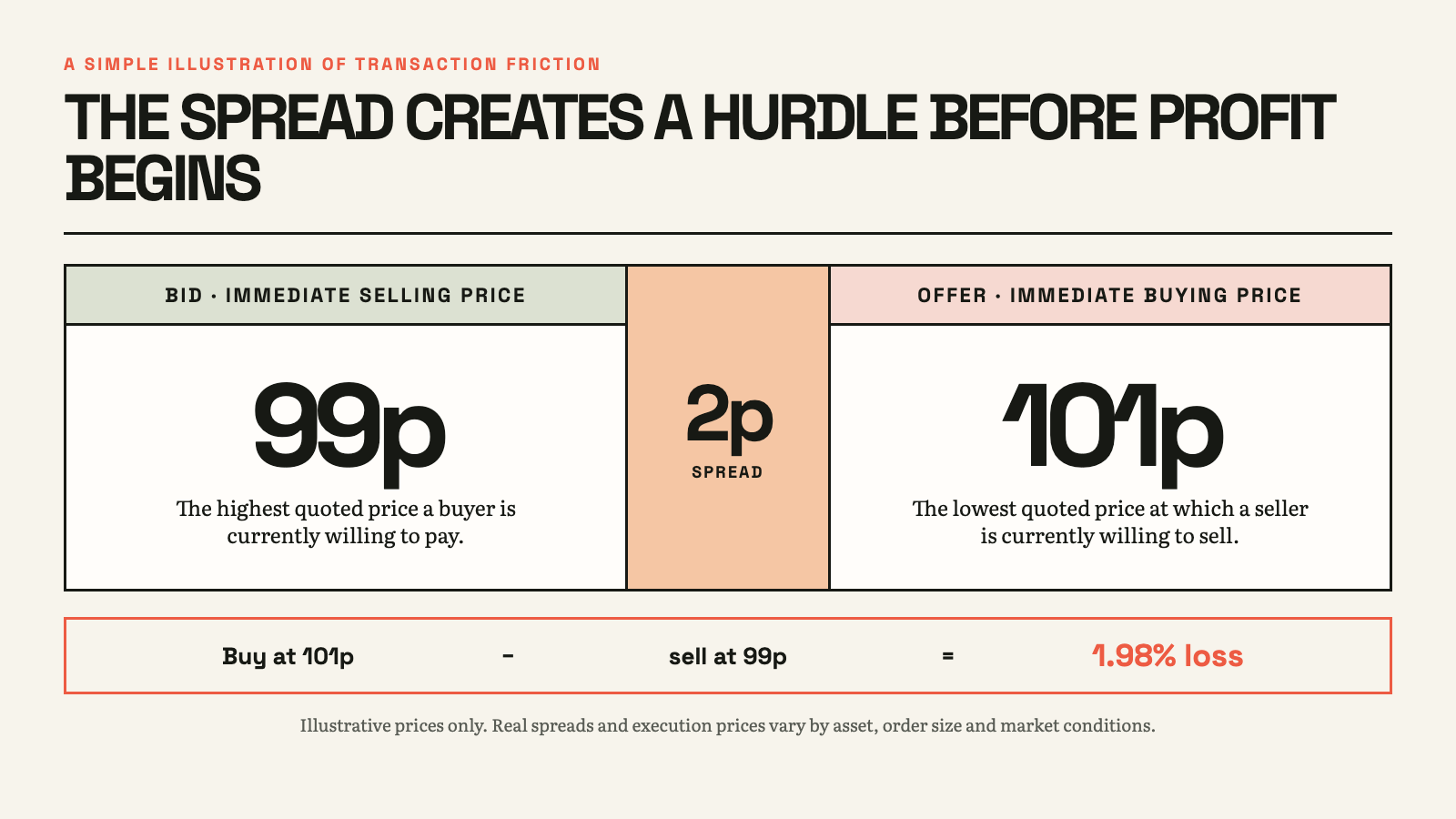
This does not represent a typical spread; it is deliberately simple arithmetic. Actual spreads vary by asset and market conditions, and the displayed quote is not always the execution price available for the whole order. The lesson is that the price must move far enough in the trader’s favour to cover friction before a net profit begins.
An investor also pays costs, including ongoing fund or platform fees where applicable. The difference is frequency. A long-term investor who trades rarely crosses transaction costs less often. A trader repeatedly starts each new position with another hurdle. More activity therefore requires more opportunities to be right after costs, not merely before them.
The two approaches demand different forms of discipline
Investor discipline is largely the ability to follow a long-term plan without mistaking activity for progress. It includes continuing regular contributions where appropriate, maintaining diversification, reviewing the portfolio at sensible intervals and changing course when the underlying evidence or personal goal changes. Patience is active restraint, not neglect.
Trader discipline is more immediate. It means waiting for a defined set-up, keeping the position within the planned risk, accepting that a valid idea can lose, and closing when the trade reaches its pre-set invalidation or time limit. It also means resisting the urge to increase risk to recover a previous loss. Because decisions repeat, small lapses can accumulate.
Both face uncertainty. The investor may misjudge an asset’s long-term prospects, pay too much, hold a poorly diversified portfolio or need the money during a downturn. The trader may misread a signal, suffer poor execution, encounter a sudden gap or discover that the apparent advantage disappears after costs. Neither label turns uncertainty into safety.
Can you invest and trade at the same time?
Yes, but the plans should not blur together. A common failure is to describe a losing trade as a “long-term investment” only after the planned exit has been ignored. The holding has not become safer; the original discipline has disappeared.
Someone using both approaches can keep separate objectives, budgets and records. Each position should be labelled before entry with its reason for being owned and its exit rules. Money reserved for a near-term goal or emergency should not be quietly moved into either activity. Separation makes it harder to rewrite the plan when a position becomes uncomfortable.
Illustrative status: general education, not a recommendation to invest or trade.
Before buying, ask
- Am I relying mainly on long-term value or a shorter-term price move?
- What evidence would show that my original case is wrong?
- When will I review or exit, and why?
- How much could I lose, including a worse-than-expected execution?
- What costs must be overcome?
- Does this position fit the purpose of the account in which it sits?
If those answers are vague, the immediate problem is not choosing between two labels. It is that there is no complete plan.
Practical takeaways
- Investing is mainly a decision about long-term ownership, suitability and value; trading is mainly a decision about a defined price opportunity and its timing.
- Investors should review periodically, not react mechanically to every daily move and not forget their holdings entirely.
- Traders need an entry, an exit, a position size and a clear reason the set-up would be invalid before they commit money.
- Stop-loss orders can help implement a plan, but they do not guarantee the stop price.
- Spreads, fees and execution differences affect both approaches, but frequent trading encounters transaction costs more often.
- The asset alone does not decide whether someone is investing or trading. The objective, evidence, time horizon and exit rule do.
The practical difference, then, is not that investors think while traders merely act, or that one approach is always safe and the other always reckless. They solve different problems. An investor asks whether an asset remains worth owning for a long-term purpose. A trader asks whether a particular opportunity still justifies a defined amount of short-term risk. Confusing those questions is where discipline usually begins to break down.