Plain answer
A conventional stop-loss sets a trigger, not a guaranteed sale price. Gaps, speed and limited liquidity can produce a different execution.
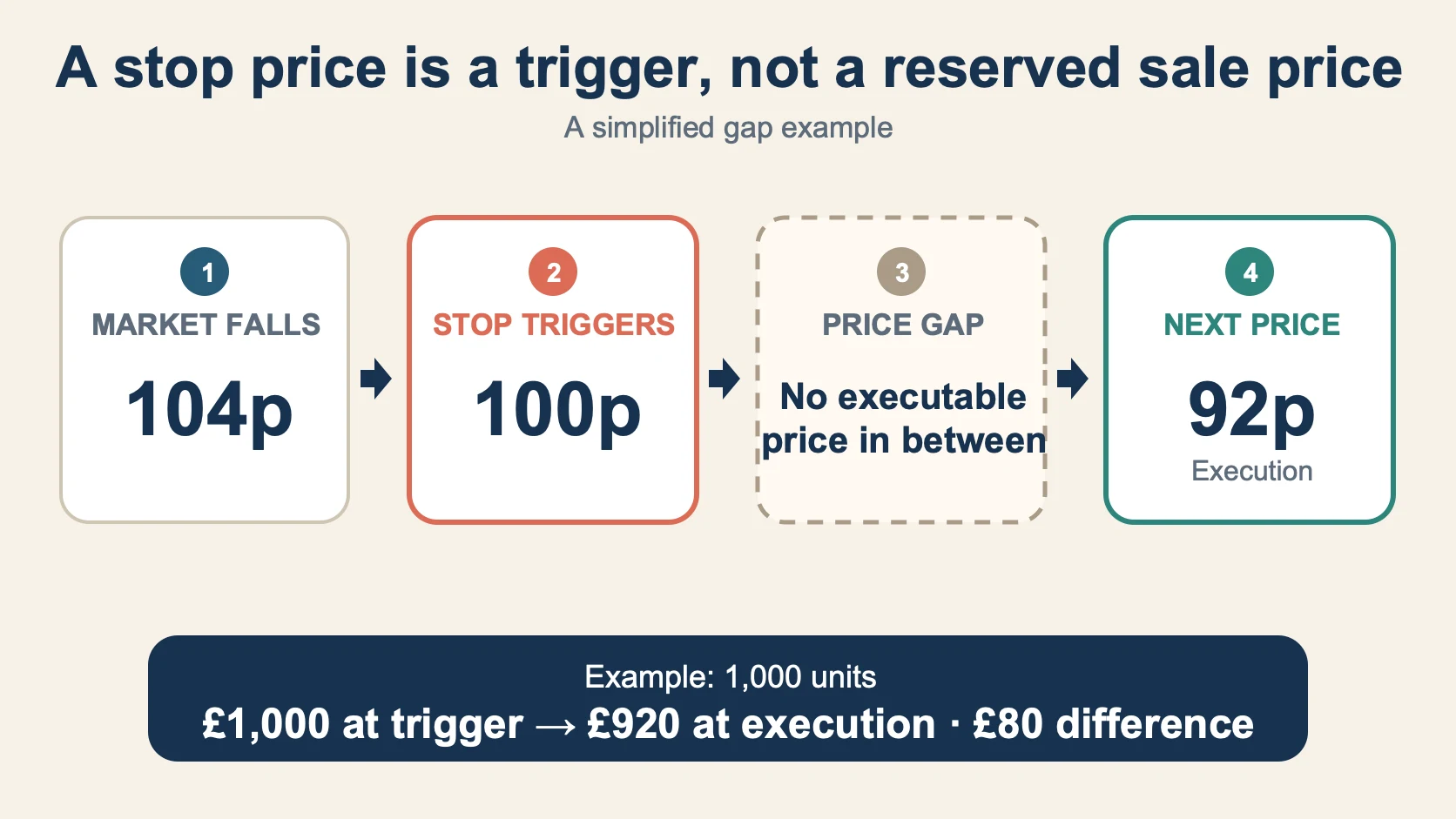
A trader sets a stop-loss at 100p. The market falls overnight and the position is sold at 92p. The instruction worked, but not at the price the trader expected.
That is possible because a conventional stop-loss normally sets a trigger, not a guaranteed sale price.
Understanding that difference is essential. A stop can help control risk, but it cannot create a buyer at a price that the market has skipped.
The plain-English answer
A standard stop-loss generally waits until a specified level is reached. It then triggers an order to close the position, often at the next available market price.
If the market moves gradually through the stop and enough buyers are present, the execution may be close to the trigger. If it gaps from one price to another, moves quickly or has little available depth, the fill can be worse.
The difference between the expected price and the actual execution price is commonly called slippage.
Order types and trigger rules vary by provider and market. Read the actual terms rather than assuming every button labelled “stop” behaves identically.
For the broader distinction between holding an asset and actively managing an entry and exit, start with trading versus investing.
Trigger price is not execution price
Suppose a trader owns 1,000 shares that were trading at 104p before the market closed, and sets a conventional stop at 100p.
While the market is closed, bad news arrives. The next available bid when trading resumes is 92p. There were no executable bids at 100p, 99p or 95p on the route down because the market reopened lower.
If the order sells all 1,000 shares at 92p:
- value expected at the 100p trigger: £1,000
- value actually received: £920
- difference caused by slippage: £80
The stop instruction may have triggered exactly as designed. What it could not do was guarantee liquidity at 100p.
Trade Friction Visualiser
Turn a quoted difference into pounds. Choose the spread or stop-loss view, change the assumptions and see which part of the outcome comes from execution friction.
Quote and quantity
Excludes commission, tax, currency conversion, market depth and later price changes.
Trigger and available price
Shows a sell-stop example and excludes the earlier gain or loss, spread, commission, tax and partial fills.
Formulas and limitations
Spread percentage = (offer − bid) ÷ midpoint. Immediate spread friction = (offer − bid) × quantity. Stop execution difference = (trigger − execution) × quantity. These are simplified educational calculations, not live prices or a forecast of execution.
Use the Stop tab to change the trigger, next available price and quantity. The tool shows the difference attributable to execution price only. It does not include the earlier loss from the entry price, spread, commission, tax or currency conversion.
What is a price gap?
A gap occurs when the next tradable price is materially different from the previous one, with no trades at the prices between them.
Gaps can appear after company news, economic announcements, market closures or a sudden imbalance between buyers and sellers. They are particularly important in markets that trade only during set hours and in less liquid securities.
The stop level can be crossed during the gap. Once the order is active, it must meet the prices that actually exist, not the missing prices on the chart.
This is the order-execution version of yesterday’s bid-offer spread lesson: a screen can display an instruction or reference price without guaranteeing that it is executable for the required quantity.
Four prices that should not be confused
A stop-loss example may involve four different numbers:
- Entry price: what was paid when the position opened.
- Stop or trigger price: the level that activates the closing instruction.
- Available market price: the bid or offer available when the order reaches the market.
- Execution price: the price, or average price, at which the trade actually completes.
The execution price can differ from the first available quote if the market moves again, the order waits in a queue or the required quantity is larger than the depth at one price.
An average fill also matters. If 300 shares sell at 92p and 700 at 90p, the average execution is 90.6p, not 92p.
Standard stops, stop-limit orders and guaranteed stops
The names and mechanics vary, but three broad structures are useful to understand.
Standard stop
The trigger activates an instruction that prioritises getting out. It offers no absolute execution-price guarantee, so slippage is possible.
Stop-limit order
The trigger activates a limit order that refuses prices beyond a boundary. This adds price control but creates a new risk: the order may not execute, leaving the position open while the market continues to move.
Guaranteed stop
Some providers offer a contractual guarantee that a position will close at the specified level, subject to their terms, eligible markets, minimum distances and charges or premiums. This transfers some gap risk to the provider; it is not simply a more precise version of a free standard stop.
These descriptions are concepts, not a promise about a particular platform. Check what triggers the order, which reference price is used, whether it can fill partially and what happens outside normal trading hours.
Why a stop is still useful
Slippage does not make stop-losses pointless. A stop can automate an exit, reduce hesitation and define how a trading plan responds when the market reaches a chosen level.
But it should be one layer of risk control, not the whole structure.
Edition 2 explained how a trader can limit the damage from being wrong. Position size comes first because it limits the pounds exposed before the order meets the market. A smaller position makes both the planned loss and possible slippage more survivable.
That distinction matters:
- the stop expresses the intended exit;
- the market determines what can be executed; and
- position size determines how much the difference can hurt.
A pre-trade stop checklist
Before relying on a stop, ask:
- Which price triggers it: bid, offer, last trade or another reference?
- What order is created after the trigger?
- Can the market gap while it is closed?
- Is the asset liquid enough for the intended quantity?
- Can the order fill at several prices?
- Is a stop-limit more likely to leave the position open?
- Does a guaranteed version exist, and what are its terms and cost?
- Is the position small enough to tolerate a worse fill?
The FCA’s best-execution framework is a useful reminder that execution involves more than price alone. Cost, speed, likelihood, size and nature can all affect how an order is handled.
The useful conclusion
A stop-loss is an instruction to act when a condition is met. A conventional stop is not a reservation for a trade at the trigger price.
The gap between trigger and execution is not merely a technical footnote. It is part of the risk. Plan in pounds, allow for imperfect fills and make the position size robust enough that the plan can survive them.
Next, the edition moves from the execution of a trade to the claim represented by each share: what happens when a company issues more shares.
Sources
- FCA COBS 11.2A: Best execution — factors relevant to client order execution.
- London Stock Exchange: Guide to the Trading System (MIT201), issue 15.8 — exchange-level mechanics for stop and stop-limit orders.
- IG: What types of orders do you offer? — current provider-specific examples of stop, limit and guaranteed-stop terminology.
- IG: Order execution policy — an example of how a regulated provider documents execution arrangements.
This article and visualiser provide general financial education, not personal trading advice. Provider rules differ and should be checked before placing an order.