Plain answer
Issuing new shares can reduce an existing holder’s percentage ownership. A placing example shows the maths and the questions the percentage cannot answer.
A company has not split its existing shares and your account still shows the same number. Yet your percentage ownership has fallen.
That can happen when the company creates and issues additional shares. Your slice has not physically shrunk; the pie has been divided into more slices.
This is share dilution. It is easy to describe and easy to misunderstand.
The plain-English answer
If a company issues new shares and an existing shareholder does not receive or buy a proportionate number, the shareholder owns a smaller percentage of the company.
Dilution can also reduce each share’s claim on measures such as earnings per share. But it does not automatically mean that the company or each share has become less valuable. The company receives something in return for the new shares, usually cash, and that capital may strengthen or grow the business.
The real questions are:
- how many shares are being issued;
- at what price and to whom;
- why the money is needed;
- what existing shareholders can do; and
- whether the new capital is likely to create more value than the dilution costs.
If “small cap” is unfamiliar, begin with what a small-cap company is. Dilution can affect companies of any size, but capital raisings can be especially significant for smaller businesses.
Worked example: a placing
A placing is a sale of new shares to selected investors, commonly used to raise capital relatively quickly.
Imagine a company with:
- 10 million shares already in issue;
- a market price of 100p per share; and
- an investor who owns 100,000 shares.
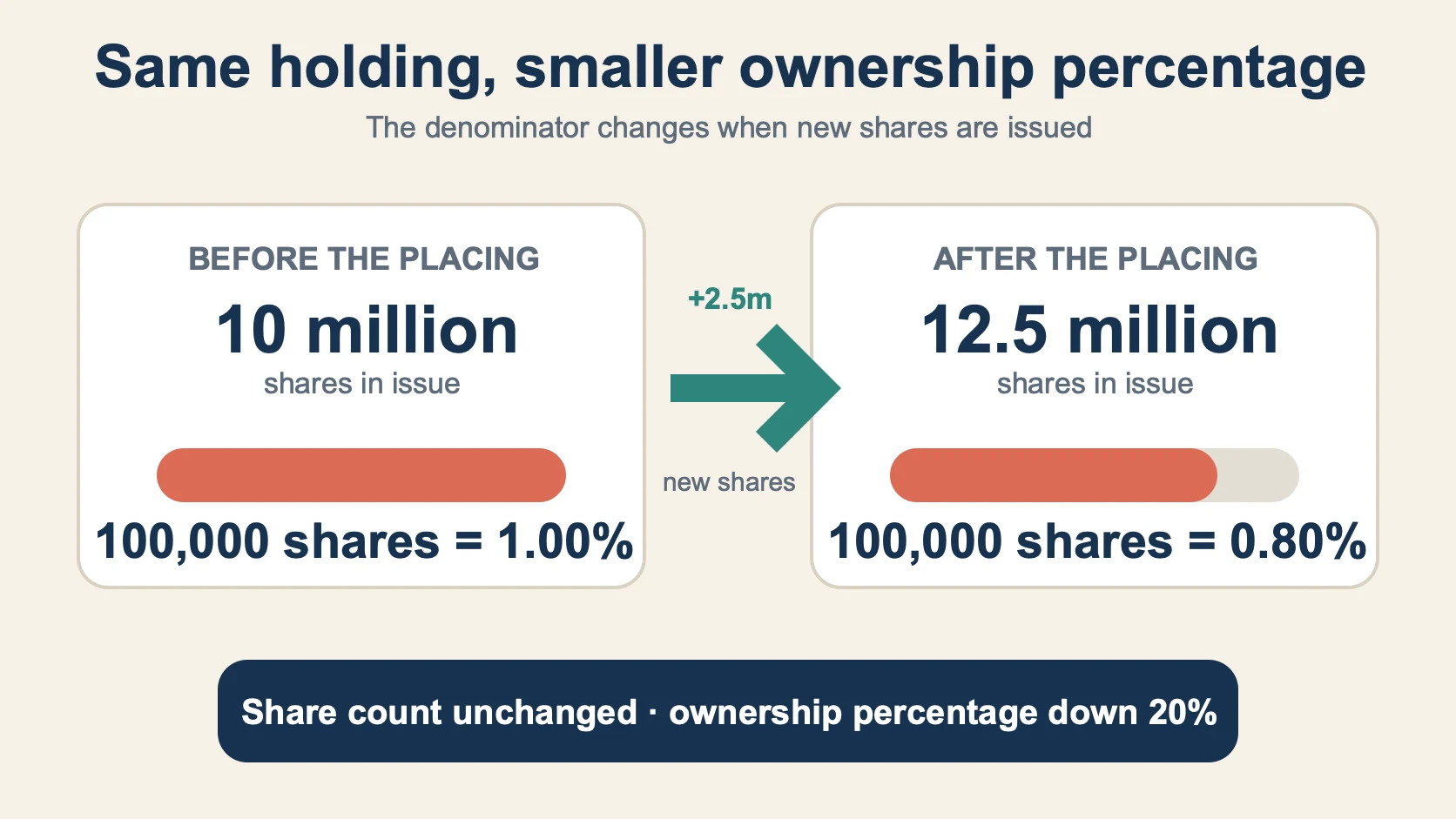
Before the placing, that investor owns 1% of the company.
The company then issues 2.5 million new shares at 80p each, raising £2 million before costs. The new shares are sold to other investors and the existing holder does not participate.
| Before placing | After placing | |
|---|---|---|
| Shares in issue | 10,000,000 | 12,500,000 |
| Existing investor’s shares | 100,000 | 100,000 |
| Existing investor’s ownership | 1.00% | 0.80% |
| Company cash raised | — | £2,000,000 gross |
The investor’s share count has not changed, but their ownership has fallen from 1.00% to 0.80%. That is a 20% relative reduction in their percentage ownership.
It is not correct to say they have lost 20% of their shares. They still have 100,000. What changed is the denominator: there are now more shares in total.
What happens to earnings per share?
Suppose the company had annual earnings of £1 million before the placing.
- Before: £1 million divided by 10 million shares = 10p earnings per share.
- Immediately after, if earnings have not changed: £1 million divided by 12.5 million shares = 8p earnings per share.
This is a simplified annualised illustration. Reported basic earnings per share normally uses the weighted-average number of shares outstanding during the reporting period, so the timing of an issue matters.
That is earnings dilution.
Now suppose the £2 million is invested well and, after time, annual earnings rise to £1.25 million. Earnings per share would return to 10p: £1.25 million divided by 12.5 million shares.
This is deliberately simple. Real earnings, tax, fundraising costs, timing and market expectations are uncertain. The example shows why “more shares” is only half the analysis. The other half is what the company receives and achieves.
Does a discounted placing make the dilution worse?
A placing price below the previous market price can transfer value towards the investors allowed to buy the discounted shares, particularly when existing holders cannot participate.
But the old market price is not a guaranteed measure of the company’s value after the announcement. Investors may revise their view because the company needs cash, because the balance sheet becomes safer, because the project looks attractive or because the fundraising terms are unexpectedly weak.
Separate three effects:
- ownership dilution: the percentage claim falls;
- per-share dilution: a measure such as earnings is divided among more shares; and
- market repricing: buyers and sellers reassess the whole situation.
These effects can occur together, but they are not interchangeable.
Edition 2 explained why small-cap prices can move sharply. A placing announcement can combine new information, a discounted issue price and limited liquidity, so the share-price response may be abrupt.
Placing is not the only route to dilution
New shares can arise through several mechanisms:
- rights issue: existing shareholders receive rights to buy new shares, normally in proportion to their holdings;
- open offer: qualifying holders can apply for new shares, although the rights are generally less freely transferable than in a rights issue;
- placing: selected investors buy newly issued shares;
- employee options or awards: new shares may be issued when incentives vest or options are exercised; and
- convertible securities: debt or another instrument can convert into shares under specified terms.
Potential dilution can therefore exist before the final shares appear. Annual reports and fundraising announcements often disclose options, warrants or convertible instruments that could increase the share count later.
What does UK company law protect?
The Companies Act 2006 sets rules around directors’ authority to allot shares. It also provides statutory pre-emption rights for certain cash issues: broadly, qualifying new equity securities are first offered to existing holders in proportion to their holdings unless those rights are disapplied or an exception applies.
That is a starting principle, not a promise that every shareholder can join every fundraising. Companies may have shareholder authorities to disapply pre-emption rights, and the applicable rules depend on the company, security, market and transaction.
Companies House says a company must notify it of an allotment, normally within one month, using form SH01. Listed and AIM companies also operate under market-specific disclosure and admission rules.
The Pre-Emption Group, whose secretariat the Financial Reporting Council provides, publishes principles and reporting expectations for UK listed companies seeking to issue shares for cash without first offering them proportionately to existing shareholders. These principles inform market practice but do not replace the law or a company’s specific authorities.
A practical dilution checklist
When a company announces a placing or another share issue, look for:
- the existing and new share counts;
- the percentage increase in shares;
- the issue price and discount to the prior market price;
- the gross and net money raised;
- who can participate;
- the stated use of proceeds;
- the company’s cash needs and alternatives;
- any options, warrants or convertibles still outstanding; and
- management’s record of using earlier capital.
Calculate the ownership effect with:
new ownership percentage = shares owned ÷ total shares after the issue
Then resist the temptation to stop. A mathematically precise dilution percentage cannot tell you whether the capital raise improves the business.
The useful conclusion
When a company issues more shares, an existing holder who does not participate usually owns a smaller percentage. Per-share measures may also fall unless the new capital produces enough additional value.
Dilution is therefore neither automatically disastrous nor harmless. It is a change in the claim represented by each share. Judge the scale, price, participation rights, reason and likely use of the money together.
The final lesson takes the edition from ownership on a company register to practical control of a digital asset: the risks chosen when crypto is kept with an exchange or in a wallet.
Sources
- Companies Act 2006 — statutory framework including allotment authority and pre-emption rights.
- Companies House: Life of a company, part 2 — allotment filing requirements.
- FRC Pre-Emption Group overview — principles for non-pre-emptive cash issues by UK listed companies.
- London Stock Exchange: AIM Rules for Companies, January 2026 — AIM admission and disclosure context.
This article is general financial education, not a recommendation to buy, sell or participate in a fundraising. Transaction terms and shareholder rights require case-specific checking.