Plain answer
A small-cap company is a listed company with a relatively small market capitalisation: the market value of all its outstanding shares. You calculate it by multiplying the current share price by the number of shares outstanding. There is no universal cash cut-off, so ‘small-cap’ depends on the market, index or fund making the classification.
“Cap” is short for market capitalisation. It is a measure of the stock market’s current value for a company’s equity, not a description of its offices, workforce, sales or popularity.
That distinction sounds simple, but it prevents several common mistakes. A low share price does not necessarily mean a company is small. A familiar brand is not necessarily a large-cap. And a small-cap is not automatically cheap, young, fast-growing or financially weak. The label tells you how the market currently values the company’s shares. It does not tell you whether those shares are good value.
How market capitalisation is calculated
The basic calculation is:
Market capitalisation = current share price × shares outstanding
Plain English definition
Shares outstanding
All the company’s shares that currently exist and are held by shareholders. This includes shares held by ordinary investors, founders and institutions. It is not the number of shares traded that day.
Suppose a company has 100 million shares outstanding and each share trades at £2. Its market capitalisation is:
100 million × £2 = £200 million
The figures are illustrative. They show how the calculation works; they do not value a real company or suggest that £200 million is a universal small-cap boundary.
Now compare that business with one whose shares trade at 20p. The second share may look cheaper because the number printed beside it is lower. But if that company has two billion shares outstanding, its market capitalisation is £400 million. On this measure, it is twice the size of the £2-a-share company.
This is why share price alone tells you very little about company size or value. The number of shares matters just as much.
Purpose: show why share price alone cannot be used to compare company size.
Share price is only half of the calculation
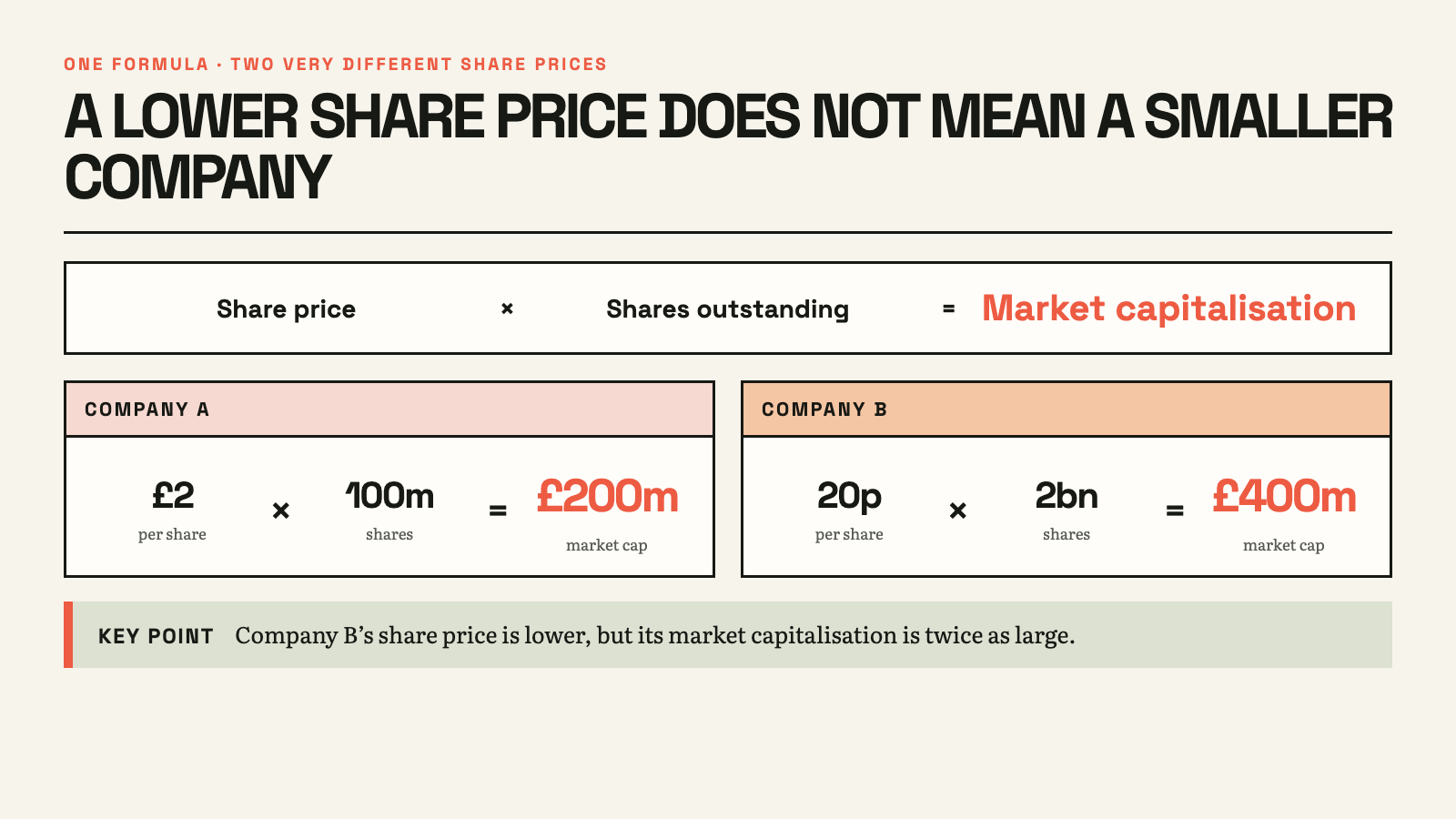
Share price is only half of the calculation. Company B has the lower share price but twice the market capitalisation because it has many more shares outstanding.
Text equivalent: £2 multiplied by 100 million shares gives a £200 million market capitalisation. Twenty pence multiplied by two billion shares gives £400 million. The lower-priced share belongs to the company with twice the market capitalisation.
Market capitalisation also moves. If the share price rises while the share count stays unchanged, market capitalisation rises. If the price falls, it falls. If a company issues or cancels shares, the share count changes too. A company can therefore move between small-cap, mid-cap and large-cap classifications without its factories, staff or revenue changing overnight.
Why there is no single small-cap cut-off
“Small-cap” is a relative category, not a protected legal definition. Index providers, fund managers and research firms can divide the market in different ways.
Some providers use fixed monetary bands. Those bands are often designed for a particular country and currency, and they can become dated as markets grow or shrink. Others rank all eligible companies and define small-cap as a segment below the largest companies. A fund may use the definition in its prospectus, which might not match a well-known index.
That means two products carrying “UK small-cap” in their names can hold different companies. One may follow a Main Market index. Another may invest more widely across smaller companies, including businesses traded on AIM. Neither description is necessarily wrong, but readers should check the methodology before assuming the labels are interchangeable.
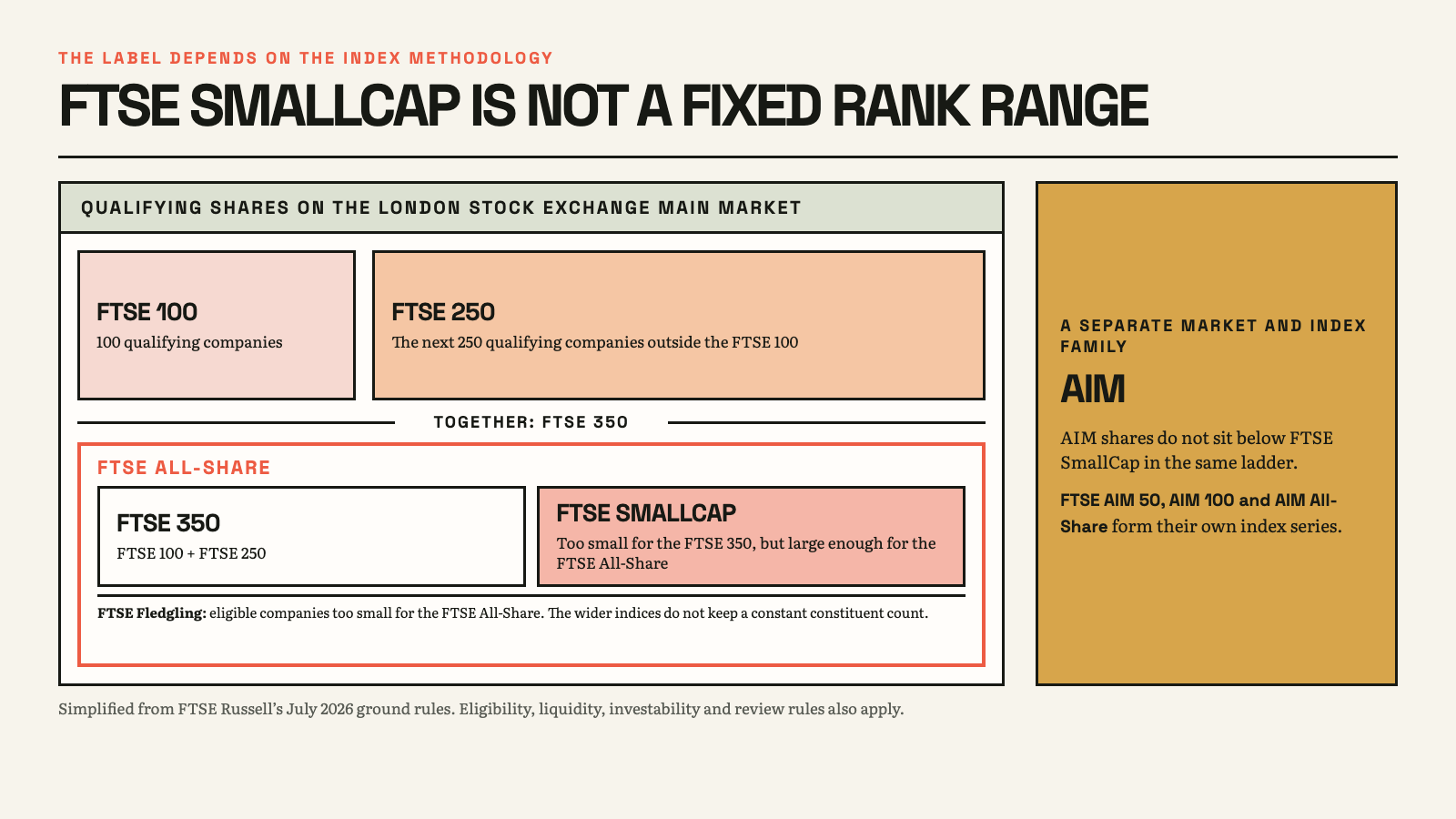
For a UK example, the current FTSE UK Index Series is more accurate than the often-repeated claim that the FTSE SmallCap always covers companies ranked 351st to 619th. Under FTSE Russell’s July 2026 ground rules:
- the FTSE 100 contains 100 qualifying companies;
- the FTSE 250 contains the next 250 qualifying companies outside the FTSE 100;
- together they form the FTSE 350;
- the FTSE SmallCap contains eligible UK companies in the FTSE All-Share that are not large enough for the FTSE 350; and
- the FTSE All-Share combines the FTSE 350 and FTSE SmallCap and aims to represent at least 98% of the full market capitalisation of companies eligible for the series.
The lower boundary is therefore coverage-based rather than a permanent numbered finishing place. Membership can change at index reviews, and companies must meet eligibility and screening rules as well as the size test. The current rules restrict the FTSE UK Index Series to qualifying shares admitted to the London Stock Exchange’s Main Market. AIM shares are not constituents of this series.
FTSE Russell also maintains a FTSE Fledgling Index for eligible Main Market companies that are too small for the FTSE All-Share. AIM has its own index family. This is a useful reminder that “below the FTSE 350”, “in the FTSE SmallCap”, “listed on AIM” and “a small company” are not four ways of saying the same thing.
Full market capitalisation and investable market capitalisation
There is one more distinction worth knowing. Full market capitalisation uses all outstanding shares covered by the methodology. Investable market capitalisation adjusts for shares that are not readily available to public investors, sometimes called the free float.
For example, a founder, government or parent company may own a large block that is not normally traded. The company’s full market capitalisation can be much larger than the value of shares the public can readily buy. Index providers may use full market capitalisation to rank a company by size but use an investability adjustment when calculating its weight in an index.
You do not need to reproduce an index provider’s rulebook before buying a share. You should, however, know which number a screen, fund or article is using. A label without a stated methodology can create false precision.
What the small-cap label changes for an investor
Market capitalisation does not determine the quality of a business, but company size can affect the practical experience of owning and trading its shares. These are tendencies, not rules for every company.
Trading may be less liquid
Liquidity means how easily shares can be bought or sold in a useful quantity without moving the price substantially. Smaller-company shares often attract less trading than the most widely held large-cap shares. That can mean fewer buyers and sellers are available when you want to trade.
One visible cost is the bid-offer spread: the gap between the highest price a buyer is offering and the lowest price a seller is asking. If the best bid is 98p and the best offer is 102p, the quoted spread is 4p. An investor buying at 102p could not immediately sell at the same price; the available bid is 98p, before any platform fees or taxes.
Research published by the US Securities and Exchange Commission on smaller exchange-listed shares found lower trading volume, wider quoted spreads and shallower order books among the smallest market-cap groups in its sample. That US evidence does not set the spread for a UK share, but it supports the general mechanism: a thin market can make trading more costly and make larger orders harder to execute at one price.
Before trading an individual small-cap share, look at the current bid and offer, recent trading volume and the size available at those prices. A limit order, which sets the worst price you are prepared to accept, can give more price control than a market order. It does not guarantee execution.
Independent research may be thinner
Large companies tend to attract more professional analysts, financial journalists and institutional investors. Some small companies have several analysts following them; others have little or no independent coverage.
The FCA’s 2021 analysis of UK public companies found that lack of analyst coverage was concentrated among lower market-cap companies. Academic research has also found a positive relationship between company size and the number of analysts providing coverage. Coverage can change, and broker research is not the same as an independent assurance report, so the number of analysts should never substitute for reading company disclosures.
Less coverage does not prove that a share is mispriced. It means the investor may have fewer external forecasts and challenges against which to test management’s account. Company announcements, annual reports, cash-flow statements and notes to the accounts become especially important. Issuer-sponsored research can be useful, but its funding and possible conflicts should be clear.
Raising new equity can dilute an investor’s stake
Growing companies sometimes raise money by issuing new shares. This can finance expansion, an acquisition, product development or the repair of a weak balance sheet. The purpose and terms matter more than the fact that a fundraising occurs.
If a company has 100 million shares and issues another 25 million, an investor who owns one million shares and does not participate still owns one million shares. But their proportion of the company falls from 1% to 0.8%. That is ownership dilution.
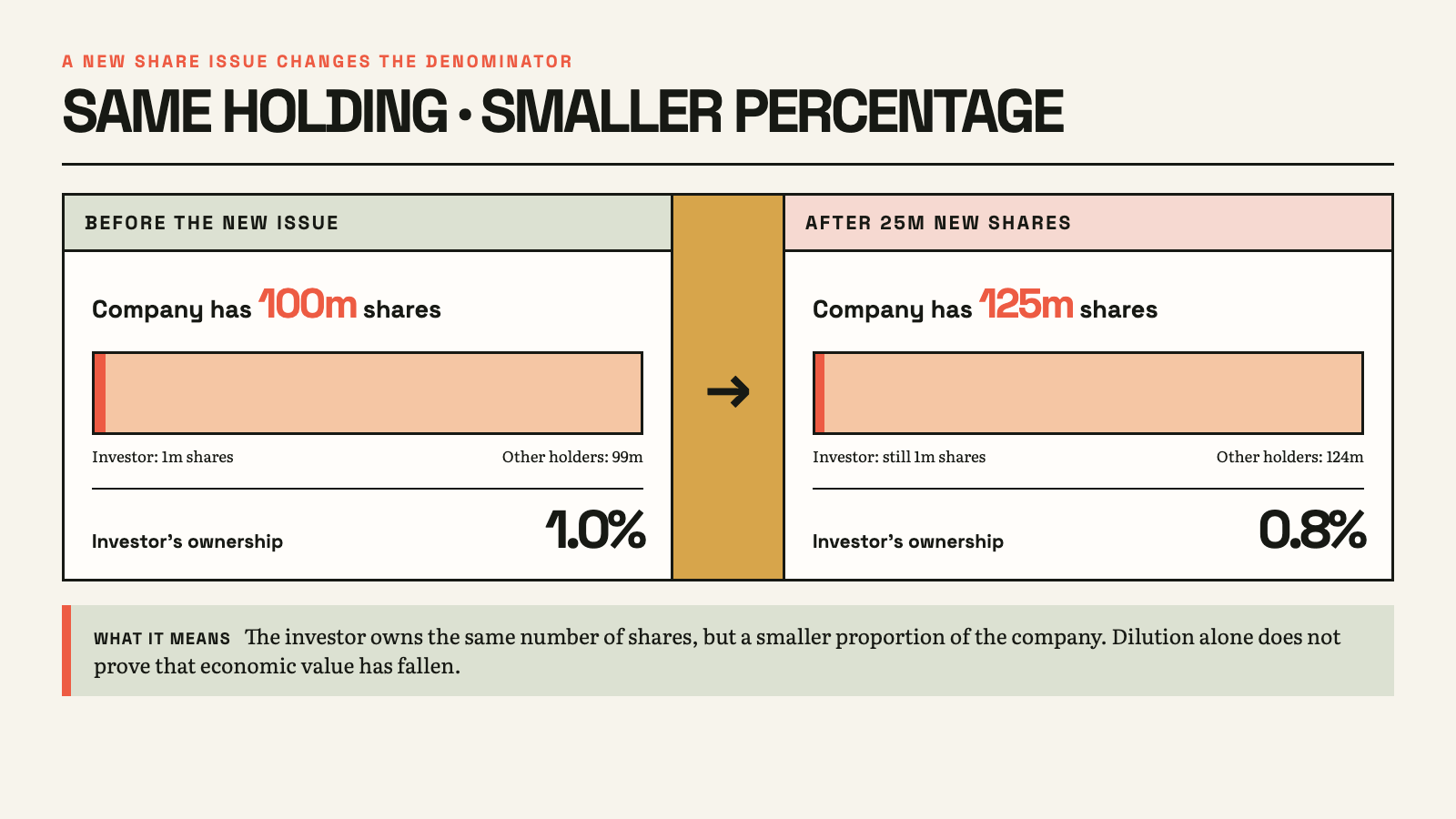
Dilution does not by itself prove that value has been destroyed. If the new capital is invested well, the larger company may become more valuable. But issuing shares at a steep discount, raising money repeatedly without adequate progress, or excluding existing holders from favourable terms can be warning signs. Check how much is being raised, the issue price, the increase in the share count, the use of proceeds and whether existing shareholders can participate.
What small-cap does not tell you
A size label is a starting point for research, not an investment case.
It does not tell you whether the business is profitable. Two companies with the same market capitalisation may have completely different revenue, debt, cash generation and prospects.
It does not tell you whether the shares are cheap. A £100 million company can be overvalued; a £10 billion company can be undervalued. Valuation compares price with something economically meaningful, such as earnings, cash flow, assets or a carefully assessed future.
It does not guarantee faster growth. A smaller base may leave more room to expand, but room is not the same as ability. Competition, weak demand, poor execution or lack of finance can prevent growth.
It does not identify the trading venue. AIM is the London Stock Exchange’s market for smaller and medium-sized growth companies, but not every AIM company has the same risk or market value. Nor does every company commonly described as a UK small-cap trade on AIM; the FTSE SmallCap is a Main Market index.
It does not make diversification automatic. A portfolio holding five small oil explorers is exposed to many of the same sector and financing risks even though it contains five separate shares.
Illustrative status: general education, not a recommendation to buy, sell or hold an investment.
A practical small-cap checklist
When a share, fund or article uses the term “small-cap”, ask five questions.
- Who defines the label? Find the index methodology, fund prospectus or screening rule. Do not assume one provider’s cut-off applies everywhere.
- Which market and date does it cover? A classification can be UK-specific, global or regional, and a company can move between segments as its price and share count change.
- Can you trade the amount you want at a sensible price? Check the bid-offer spread, recent volume and order size. Market capitalisation is not a direct measure of daily liquidity.
- What evidence can you inspect? Read regulated company announcements and financial statements. Note how much analyst coverage exists and whether any research is paid for by the issuer.
- Could the company need more capital? Examine cash, debt, cash burn, commitments and management’s funding plans. Model the effect of a possible new share issue rather than treating dilution as an abstract risk.
For a fund, add a sixth question: what does it actually hold? The name “small-cap fund” does not reveal its country exposure, sector concentration, active decisions, charges or whether it tracks an index.
The useful meaning of small-cap
The cleanest definition is also the most limited: a small-cap is a listed company whose total equity market value is small relative to a defined market or methodology.
That definition matters because it tells you what the label can and cannot do. It can help group companies by stock-market size. It can point you towards practical issues such as liquidity, research coverage and possible funding needs. It cannot tell you whether a company is sound, whether its shares are good value or whether they suit a particular investor.
Use market capitalisation as the first line on the map, not the destination. Calculate it, check who defines the boundary, then move on to the business, balance sheet, valuation, governance and trading conditions.
Practical takeaways
- Market capitalisation is the share price multiplied by the number of outstanding shares.
- “Small-cap” is relative; there is no universal monetary boundary.
- The FTSE SmallCap is not a fixed “351st to 619th” list under the current rules, and it does not include AIM shares.
- A low share price does not mean a low market capitalisation.
- Smaller shares can have thinner liquidity and less analyst coverage, but these are tendencies to investigate, not assumptions to apply blindly.
- A new share issue can reduce an existing holder’s percentage ownership if they do not participate.
- Market capitalisation classifies size. It does not establish quality, value or suitability.