Plain answer
A conventional stop prioritises getting an order into the market after its trigger, but the fill can be worse than that trigger. A stop-limit adds a price boundary, but that protection can prevent execution and leave the position open.
A stop-loss and a stop-limit can share the same trigger yet produce opposite disappointments. One may sell below the trigger. The other may not sell at all.
That is not a contradiction. The two orders give different instructions after the trigger is reached. Understanding the trade-off matters more than choosing the order with the more reassuring name.
If the difference between trading and investing is still blurred, start with how trading and investing differ in practice. Both order types discussed here manage an instruction; neither makes a risky position safe.
The trigger is not the sale price
A trigger is the event that activates an order. It is not a promise that another market participant will trade at that price. After activation, the instruction still has to meet the available buyers or sellers.
On the London Stock Exchange’s SETS order book, its current trading guide says a stop order becomes an unpriced market order after election, while a stop-limit becomes a limit order. It also specifies the last automated trade as the trigger reference for those order types on that system. Another venue or provider can use different names, trigger references, eligible markets or expiry rules.
This article therefore explains the general trade-off and uses LSE rules and named UK provider documents as examples. Before placing either order, check the terms that actually govern the account and instrument.
What a conventional stop tries to do
For a long position, a sell stop sits below the current market. Once triggered, it normally releases an instruction that prioritises execution at the best available prices. That can help a trader exit a falling position without watching every trade.
Its failure risk is slippage: the difference between the expected or trigger price and the actual fill. A market can move through the trigger between trades, gap lower between sessions or have too few buyers at nearby prices. A large order can also fill across several price levels.
The stop answers, “When this trigger occurs, start trying to get me out.” It does not answer, “Guarantee that I receive the trigger price.”
What a stop-limit adds
A sell stop-limit combines two prices. The stop price activates the instruction. The limit price sets the lowest price at which the trader is willing to sell. Once triggered, the order can execute at the limit or better, but not below it.
That boundary removes one unpleasant outcome: a completed sale below the stated limit. It creates another: if buyers are available only below the limit, no trade takes place. The position remains exposed while the market may continue falling.
The stop-limit answers, “Start trying to sell after this trigger, but never below my boundary.” It cannot also say, “Make sure the whole position is sold.” Price control and execution certainty cannot both be guaranteed by the instruction.
One fast market, two outcomes
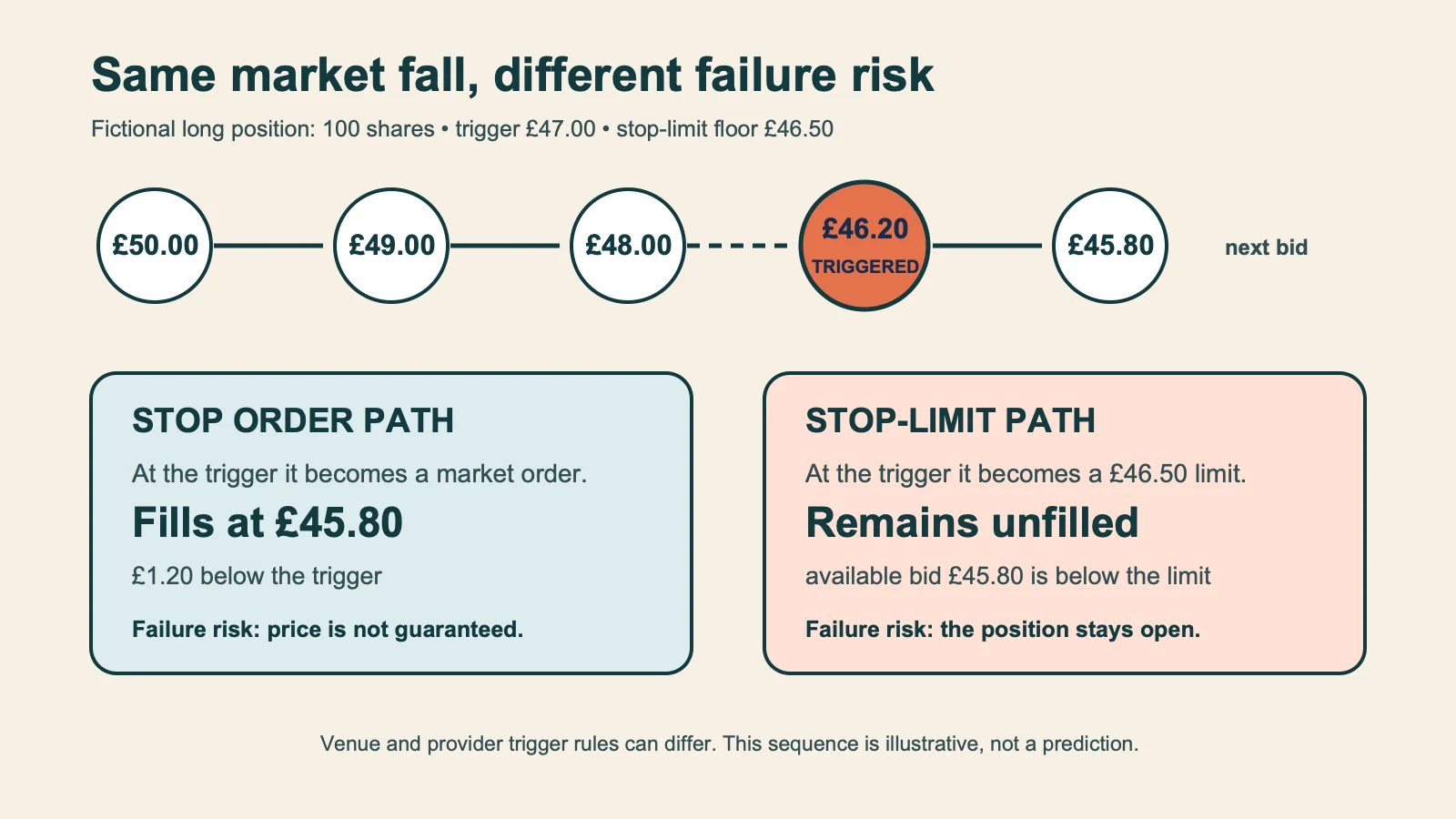
Consider a fictional long position of 100 shares. Recent trades occur at £50, £49 and £48. The trader sets a £47 trigger. For the stop-limit version, the lowest acceptable sale price is £46.50.
The next reported trade is £46.20. It crosses the trigger, so both instructions are activated under the example. The next available bid — the best visible price at which somebody is willing to buy — is £45.80.
| Instruction | After the trigger | Result and failure risk |
|---|---|---|
| Sell stop at £47 | Becomes a market order | 100 shares fill at £45.80: £1.20 below the trigger |
| Sell stop-limit at £47, limit £46.50 | Becomes a limit order at £46.50 | No fill at the £45.80 bid: the position remains open |
The stop did what it was designed to prioritise: it exited. It did not preserve the trigger price. The stop-limit did what its boundary required: it refused £45.80. It did not exit. Calling either result a malfunction would miss the instruction actually given.
Four complications a simple diagram leaves out
Partial fills
There may be enough demand to buy only part of the position at an acceptable price. A market order can sweep several price levels. A limit order can fill partly and leave the rest open. “Executed” is not always all or nothing.
Gaps and auctions
Material news can move the next available trade far from the previous close. Opening and closing auctions can follow different mechanics from continuous trading. A stop cannot create liquidity at the missing prices between the last trade and the next one.
Trigger reference
A provider may trigger on a traded price, a bid, an offer or its own quoted price, depending on the product. The LSE example is not a universal rule. This is why two apparently identical £47 stops can activate at different moments on different services.
Expiry and availability
Some orders last only for the day; others may remain until cancelled or until a specified date. Not every instrument accepts every order type. A stop-limit that stays unfilled also needs an explicit decision about cancellation or amendment.
Best execution does not mean best imaginable price
FCA best-execution rules require firms in scope to take sufficient steps to obtain the best possible result, considering factors such as price, costs, speed, likelihood of execution and settlement, size and nature. That is a process obligation in context, not a guarantee that a stop fills at its trigger or that a limit order fills.
Provider execution policies explain how those factors are applied. AJ Bell, for example, describes factors including price, cost, speed and likelihood. IG’s documentation describes its own order types and warns that stops can be filled at a worse price in fast conditions. These are useful examples, but their detailed behaviour belongs to those services.
How to choose the relevant failure risk
The question is not “Which order is safer?” Safety depends on what must not fail.
- If leaving the position is the priority, a conventional stop accepts uncertain price.
- If selling below a boundary is unacceptable, a stop-limit accepts uncertain execution.
- If neither risk is acceptable, the position size, instrument or trading plan may be the real problem.
The third point is easy to miss. An order cannot repair a position that is too large for the market’s liquidity or for the trader’s capacity to absorb a gap.
In the fictional 100-share example, the conventional stop sells for £4,580 rather than the £4,700 suggested by the trigger, a £120 shortfall before costs. The stop-limit avoids that fill but still owns shares worth only £4,580 at the available bid at that moment. Its loss has not vanished; it remains unrealised and can grow if the market falls further.
This is why the limit price should not be chosen as a comforting number. A very tight boundary is more likely to block execution during a gap. A very loose boundary behaves more like accepting market risk. There is no setting that removes the trade-off, and historical price behaviour cannot guarantee where liquidity will appear next.
A pre-order checklist
- Which price or event triggers the order on this service?
- What instruction exists after triggering: market or limit?
- Can the order fill partly or across several prices?
- What happens around gaps, auctions and market closures?
- When does the order expire?
- What action follows if a stop-limit remains open?
- Is the position small enough for the instrument’s normal liquidity?
Write the answers down before the market reaches the trigger. Deciding under pressure invites a trader to cancel a stop-limit because it did not fill, or to blame a stop for accepting the very price uncertainty it was designed to accept. A pre-agreed response to a partial or missed execution is part of the order plan, not an optional reaction.
The useful conclusion
A stop exchanges price certainty for a stronger attempt to execute. A stop-limit adds a price boundary by surrendering execution certainty. The trigger starts the next instruction; it does not guarantee the outcome.
Thursday follows the constraint beneath that execution problem: even a well-written order depends on there being enough shares genuinely available to trade.