Plain answer
Saving keeps money as cash, usually for security and ready access. Investing puts money into assets with the aim of building wealth or income over years, while accepting that their value can fall. Trading involves buying and selling assets more actively to try to profit from shorter-term price movements, usually with greater demands on time, decision-making and cost control.
The three activities can use similar-looking accounts and sometimes the same assets, but they solve different problems. The useful question is not simply which one offers the highest possible return. It is what the money is for, when it may be needed, how much loss can be tolerated and how actively it will be managed.
The difference at a glance
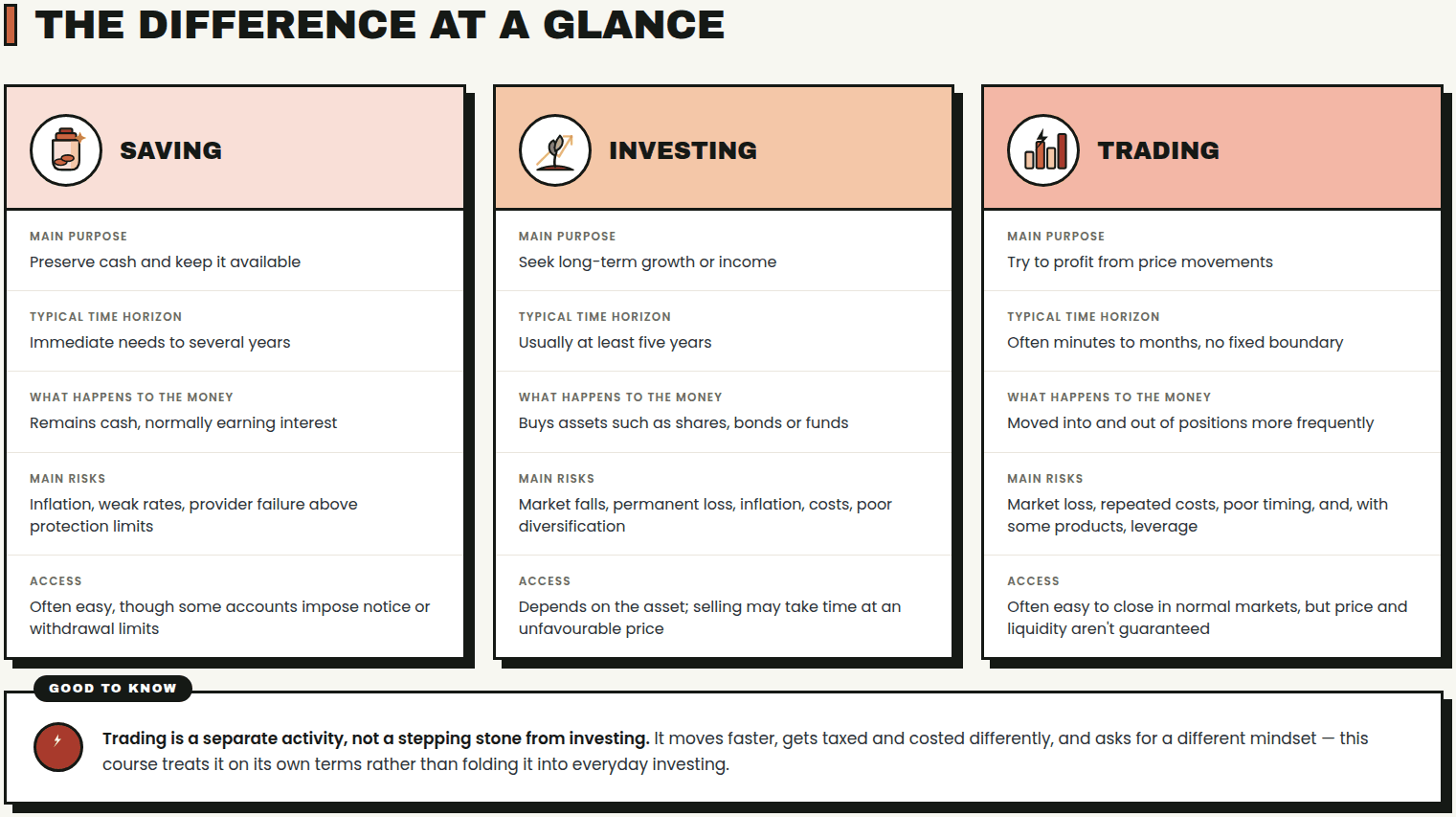
These are broad characteristics, not promises. Access terms and market liquidity vary. Purpose and method are more reliable distinctions than a stopwatch.
What saving is for
Saving means setting money aside as cash rather than exposing it to market prices. It is commonly used for emergencies, bills and goals where the amount and timing matter more than the possibility of a higher return.
Suppose £1,000 is placed in a straightforward savings account. The account balance does not rise and fall with the stock market. It may earn interest, and the rate may be fixed or variable. The bank may change a variable rate, while a fixed-term account may charge a penalty or prevent withdrawal before a specified date. “Saving” therefore does not always mean instant access, but it normally means the capital is not deliberately exposed to investment-market movements.
Eligible UK deposits have a specific form of institutional protection. If a UK bank, building society or credit union authorised by the Prudential Regulation Authority fails, the Financial Services Compensation Scheme normally protects eligible deposits up to £120,000 per eligible person, per authorised firm. The limit rose from £85,000 on 1 December 2025. Several banking brands can share one authorisation, so £120,000 is not necessarily available separately for every brand. Eligibility also matters; the protection is not a blanket guarantee for every product that looks like cash.
That protection addresses the failure of the deposit-taking institution. It does not protect the spending power of the money. If the prices of goods and services rise faster than the interest earned after any tax, the cash buys less in real terms. This is inflation risk. For example, a balance that grows by 3% while prices rise by 4% has increased in pounds but lost purchasing power. The figures are illustrative, not current rates or a forecast.
Cash provides certainty that investments cannot. If a payment must be made on a known date, avoiding a market loss immediately before it can matter more than pursuing growth. Saving is a tool for resilience and planned spending, not an inferior version of investing.
What investing is for
Investing means committing money to assets that may produce income, rise in value or both. Buying a share gives the investor part-ownership of a company. Buying a bond is different: it means lending to a government or company under specified terms. A fund pools money from many investors and holds a collection of assets according to its stated approach.
Investment returns are uncertain. Share prices can fall because a company disappoints, an industry changes or markets become less willing to pay the previous price. A bond can lose value when interest rates move or when the issuer’s ability to repay is questioned. A fund can fall because the assets it holds fall. Selling converts the investment back into cash at the price available then, which may be below the amount originally invested.
The attraction is the possibility of growth or income beyond what cash can provide. That possibility is not a guarantee, and taking more risk does not ensure a higher return. Time helps because an investor with a distant goal is less likely to be forced to sell during a temporary fall. The Financial Conduct Authority describes at least five years as a useful investing timeframe, but five years is a rule of thumb, not a point at which loss becomes impossible. Markets can disappoint over long periods, and the right horizon depends on the asset and the goal.
Diversification can reduce reliance on one company, industry, country or type of asset. It does not prevent all losses. A diversified fund may still fall when broad markets fall, but one corporate failure is less likely to decide the whole result than it would be in a portfolio containing only that company.
Platform fees, fund charges, dealing costs, taxes where applicable and the difference between buying and selling prices can reduce returns. Even a low-maintenance investor needs to understand what is owned, its risks and its costs.
FSCS protection for investments is also different from deposit protection. Depending on the regulated product, service and firm, the FSCS may compensate an eligible person if an authorised investment provider or adviser has failed and cannot meet a valid claim. It does not compensate an investor merely because an investment performed badly. Market risk remains with the investor.
What makes trading different
Trading uses many of the same markets as investing, but the aim and process change. An investor usually starts with the asset: is this business, bond or fund worth owning for the expected long-term return? A trader usually starts with a price opportunity: is the asset likely to move enough, soon enough, to justify taking a position under a defined trading method?
There is no universal holding period that turns an investment into a trade. A day trader may open and close a position within one session. A swing trader may hold for days or weeks. Another trader may hold for months. Meanwhile, an investor can sell after a short period if the original case changes. Frequency, reliance on timing and the intention to capture price movement are the clearer signals.
Trading normally demands more repeated decisions. The trader needs rules for entering, sizing and closing a position; a way to limit losses; records that show whether the method works after costs; and the discipline to follow the method when markets move quickly. Reading a chart is not a substitute for managing risk, and activity is not evidence of skill.
More transactions create more opportunities for costs to matter. A bid-offer spread is the gap between the price available to buy and the price available to sell. A position can therefore begin with a small loss even when a platform advertises zero commission. Depending on the market and product, there may also be dealing fees, taxes, currency-conversion costs or overnight financing charges. Each cost may appear small, but frequent repetition raises the hurdle a trading strategy must clear.
Some trading products, including contracts for difference, can involve leverage. Leverage means taking exposure larger than the cash committed, so a relatively small price move can produce a much larger gain or loss. It is not a necessary feature of trading, and it introduces risks beyond those of simply buying an unleveraged share or fund. A beginner-level comparison should not treat leveraged speculation as a routine shortcut to higher returns.
The same person can save, invest and trade
Saving, investing and trading are not rival identities. One person might hold emergency cash, invest for retirement and use a separate amount for trading. The labels attach to each pot’s purpose, not to the person.
The separation matters because money can acquire the wrong job. Emergency cash placed in volatile assets may have to be sold after a fall. Long-term money kept entirely in cash may lose purchasing power. A trading loss can damage an investment plan if the two pots are not kept distinct.
Trading is not a compulsory advanced stage. It is a separate activity whose time, costs and risks need their own justification.
In practice: give each pot of money one job
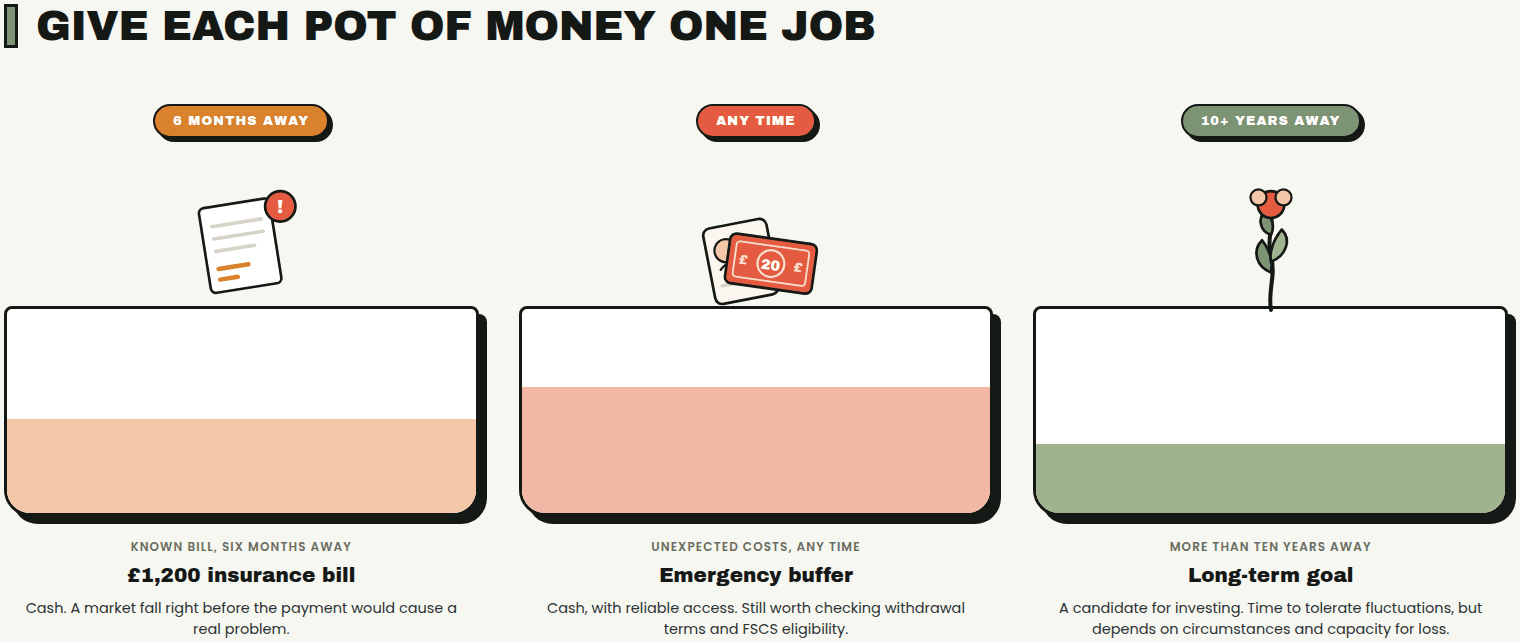
Consider an illustrative person with three goals. They want £1,200 for an annual insurance bill due in six months, a financial buffer for unexpected costs, and money for a goal more than ten years away. They are also curious about short-term trading.
The bill money has a known amount and date. Cash is the natural category because a market fall just before the payment would cause a practical problem. The emergency buffer also needs reliable access, although the saver would still check withdrawal terms and FSCS eligibility. The distant goal may be a candidate for investing because there is time to tolerate market fluctuations, but the choice would still depend on the person’s circumstances, capacity for loss and understanding of the investment.
Trading would not be a substitute for any of those pots. If explored at all, it would need money whose loss would not undermine the bill, emergency fund or long-term goal. This example demonstrates how purpose and timing separate the three activities. It does not establish that investing or trading is suitable for a particular reader, forecast any return or prescribe how much anyone should allocate.
Four questions that reveal which activity you are considering
1. What must this money do?
Money reserved for a fixed bill has a different job from money intended to build purchasing power over decades. A vague wish to “make more” is not yet a defined purpose.
2. When might it be needed?
The shorter and less flexible the deadline, the harder it is to tolerate a market fall. A long horizon creates room for recovery but does not guarantee it.
3. What loss would cause real harm?
Attitude to risk describes how a person feels about uncertainty. Capacity for loss describes what their finances can actually withstand. The second test is more important when a loss could derail an essential goal.
4. How much work and cost does the approach require?
Saving may require occasional rate and protection checks. Investing requires product research and periodic review. Trading requires a repeatable method, close risk control, records and enough evidence to distinguish skill from luck. The time commitment is part of the cost.
Common mistakes in the labels
Holding shares does not automatically make someone an investor; they may be trading them. Using an app does not automatically mean trading; the app may be used for long-term monthly investing. Keeping money in an account called an ISA does not settle the question either: a cash ISA contains savings, while a stocks and shares ISA contains investments.
Nor does “low risk” mean “no risk”. Cash faces inflation and limits on institutional protection. Investments face market and other risks that vary widely by asset. Trading adds dependence on execution, timing, behaviour and repeated costs. The practical task is to choose the type of risk that the money’s purpose can bear, rather than pretending risk can be removed entirely.
Practical takeaways
- Saving is mainly for preserving cash and keeping it available for emergencies and nearer-term spending.
- Investing is mainly for seeking long-term growth or income while accepting market uncertainty and possible loss.
- Trading is an active attempt to profit from price movements; it is not simply investing done faster.
- Purpose, deadline, capacity for loss, access, cost and required effort matter more than the label on an app or account.
- FSCS deposit protection and investment protection solve different problems. Neither protects an investor from ordinary market losses.
- One person can use more than one approach, but each pot of money should have a clear job.
The distinction is ultimately simple: saving prioritises certainty and access, investing accepts uncertainty in pursuit of long-term returns, and trading accepts a more active contest with short-term prices. Understanding which activity is taking place is the first step towards judging its risks honestly.
Evidence and educational disclosure
This article provides general education, not personalised financial advice. It does not take account of your circumstances and is not a recommendation to save, invest, trade or buy any particular product. Investment values can fall as well as rise, and you may get back less than you put in.
Sources
- Prudential Regulation Authority, PS24/25 – Depositor protection
- Bank of England, Financial Services Compensation Scheme
- Financial Services Compensation Scheme, Investment compensation and protection
- Financial Conduct Authority, The golden rules of investing
- Financial Conduct Authority, Risk and returns
- Financial Conduct Authority Handbook, DISC 6: Costs and charges information
- Financial Conduct Authority, Contract for differences
- MoneyHelper, What’s the difference between saving and investing?
Next lesson
Why do stock markets exist? This follows naturally because it explains the market infrastructure in which investing and trading take place, without assuming that the two activities have the same purpose.
Evidence · Enhanced
| Claim | Checked sources |
|---|---|
| FSCS deposit protection limit rose to £120,000 (from £85,000) on 1 December 2025 | Prudential Regulation Authority — PS24/25 – Depositor protection (checked 2026-08-19) |
| FSCS deposit protection covers eligible deposits per person per authorised firm; shared authorisations affect the limit | Bank of England — Financial Services Compensation Scheme (checked 2026-08-19) |
| FSCS investment protection differs from deposit protection and does not cover poor investment performance | Financial Services Compensation Scheme — Investment compensation and protection (checked 2026-08-19) |
| General principles for investing (diversification, time horizon, risk) | Financial Conduct Authority — The golden rules of investing (checked 2026-08-19) |
| Relationship between risk and potential returns when investing | Financial Conduct Authority — Risk and returns (checked 2026-08-19) |
| Trading costs: platform fees, dealing costs, bid-offer spread, overnight financing charges | Financial Conduct Authority Handbook — DISC 6: Costs and charges information (checked 2026-08-19) |
| Contracts for difference can involve leverage, so a small price move can produce a larger gain or loss | Financial Conduct Authority — Contract for differences (checked 2026-08-19) |
| General definitional distinction between saving and investing | MoneyHelper — What’s the difference between saving and investing? (checked 2026-08-19) |