Plain answer
Leverage creates exposure larger than the capital committed, magnifying the percentage gain or loss on that capital from the same market move. Margin, financing and forced closure also affect the result. UK retail CFD protections must not be generalised to every leveraged product or client.
Leverage lets a position respond to more market exposure than the capital committed to it. The same price movement can therefore create a much larger percentage gain or loss on that capital. It changes the size of the financial response; it does not make a forecast more accurate.
The key number is exposure, meaning the amount whose price movement drives the result. A screen showing a modest deposit can make a large position look small. Before considering the possible return, translate that deposit into the pounds exposed to the market.
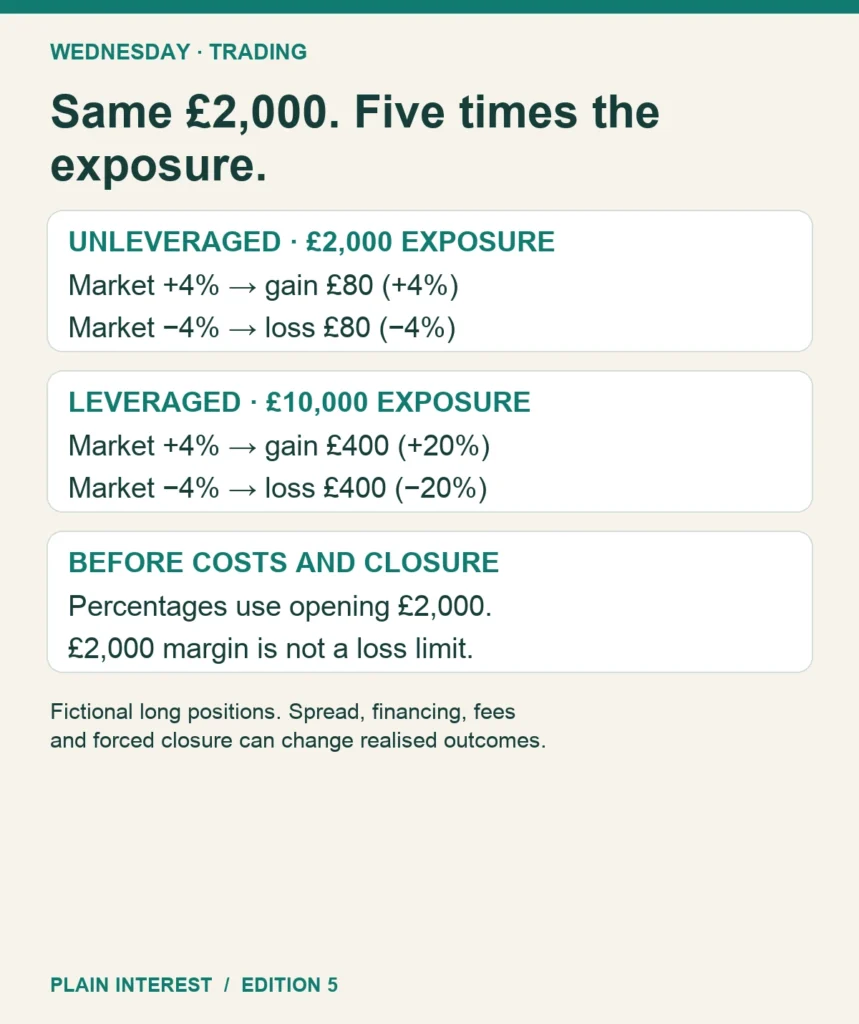
Separate exposure, margin and equity
A contract for difference, or CFD, is an agreement with a provider to exchange the difference in an asset’s price between opening and closing, subject to the contract’s terms. It generally provides price exposure without ownership of the underlying asset. Here we use a simple long position, which benefits when the relevant price rises.
Margin is the amount required to support the position. It is not the purchase price of the underlying asset and is not automatically the most you can lose. Account equity is the account’s current value after including open gains and losses and relevant charges. Different numbers can appear together on a trading screen because they answer different questions.
In a simple example, £2,000 of margin supporting £10,000 of exposure represents five-to-one leverage: £10,000 divided by £2,000. A 20% initial margin requirement produces that ratio. Five-to-one is a description of the opening relationship, not a recommendation or a promise that the account always stays at that ratio.
If the distinction between investing and trading is still unclear, begin with how trading and investing differ. The arithmetic here explains a mechanism, not whether using it is suitable.
Compare the same market move both ways
Imagine a fictional share priced at £50. Ignore fees, spread, dividends, financing and tax for this first calculation. An unleveraged £2,000 purchase buys 40 shares. A CFD position with £10,000 of exposure corresponds to the price movement of 200 shares and requires £2,000 initial margin in our example.
If the price rises 4% to £52, each share-equivalent gains £2. The unleveraged holding gains 40 × £2 = £80, or 4% of £2,000. The leveraged position gains 200 × £2 = £400, or 20% of the initial £2,000 margin.
Now reverse the move. If the price falls 4% to £48, the unleveraged holding loses £80. The leveraged position loses £400. That is minus 4% and minus 20% of the respective opening £2,000 amounts. The mechanism is symmetrical before costs: leverage magnifies the unwelcome move just as directly as the welcome one.
The £400 gain is not evidence that the leveraged instrument found a better investment. It responded to five times as much exposure. Equally, a 4% fall in the underlying price has not become a 20% fall in that underlying asset. The larger percentage is measured against the smaller amount of committed capital.
If both approaches instead carried the same £10,000 exposure, their gross response to that same 4% market move would be £400. The financing, ownership rights, costs and capital requirements would differ. Always name what you have held constant when comparing leverage.
Why a margin percentage can obscure the risk
Suppose a provider’s minimum margin requirement fell while the trader retained the same £10,000 exposure. That alone would not reduce the pounds lost on a 4% adverse move. The exposure is unchanged, so the simplified loss remains £400.
If, instead, the trader used the lower requirement to double exposure to £20,000, the same move would produce an £800 loss before costs. A change described as freeing up capital can become an increase in risk if the released capacity is used to enlarge positions.
Consider the account as well as each trade. Five positions needing £400 margin each are not automatically five small risks. Their underlying exposures may be substantial, and several may respond to the same news. Different company names do not guarantee independent outcomes.
It also matters whether the trader has additional money in the account. A £2,000 position margin is not the same denominator as £5,000 of account equity. Our £400 loss is 20% of the former and 8% of the latter. Neither calculation should be advertised without saying which capital base it uses.
Losses can bring forced closure closer
In our opening example, assume the entire account contains £2,000 and the only position requires £2,000 initial margin. A £400 open loss reduces equity to £1,600 before charges. There is now less capacity to absorb further losses, even if the position has not been closed.
Margin rules can require the provider to close positions when account equity falls sufficiently. A margin call is a warning or request for funds under the applicable arrangement; it is not a guaranteed period in which to rescue a trade. Rapid price movements and provider terms can lead to closure before a trader acts.
For UK retail CFD accounts covered by the FCA restrictions, the margin close-out protection operates at account level when net equity falls below 50% of the relevant initial margin requirement. Providers may close positions earlier under their terms. Do not read this as permission to choose exactly how much you will lose.
In a simplified one-position account with a fixed £2,000 requirement, £1,000 equity is that 50% reference level. Ignoring costs, a £1,000 loss on £10,000 opening exposure corresponds to a 10% adverse move. This arithmetic illustrates the threshold; it does not guarantee execution at that price or say every account uses our simplifying assumptions.
A price gap can defeat a tidy spreadsheet
Our calculations assume prices can be observed at the stated levels. Actual markets can jump between available prices. A provider closing a position must use the execution arrangements that apply, so the realised outcome may differ from a threshold calculation.
A stop order is another instruction, not a general cure for leverage. The earlier lesson on why a stop-loss can execute at a different price explains the execution issue. There is no need to relearn every order type here: the point is that larger exposure also makes a worse-than-expected fill more costly in pounds.
A later market recovery may not help someone whose position was already closed. Leverage can make the path of prices matter, not merely the difference between a starting chart point and an eventual recovery.
Costs also act on the larger position
Spread, commission and financing can turn the neat gain/loss comparison into a less favourable net result. The spread is the gap between buying and selling prices. Financing charges for some leveraged products relate to exposure and time held, rather than simply the margin deposit.
For a deliberately simplified funding example, a fictional 8% annual charge on £10,000 for 30 days, using a 365-day basis, is £65.75. That is about 3.29% of £2,000. It is not an actual provider quote: products use different reference rates, adjustments, day counts and charging conventions.
If the gross trading gain were £400, subtracting that assumed financing alone leaves £334.25 before other costs. If the gross loss were £400, it becomes £465.75 after that charge. Costs do not normally reverse direction merely because the trader was wrong.
Protection depends on the product and client
The FCA’s retail CFD restrictions include leverage limits that vary by underlying asset and negative balance protection at CFD-account level. Negative balance protection limits the covered account liability; it does not prevent the money in that account being lost.
Do not transfer those protections to every form of borrowing or every leveraged instrument. Futures, options, leveraged funds and borrowing against investments have different mechanics. Professional-client status and overseas providers can also change the protections available. Check the actual legal entity and client classification, not just a familiar trading brand.
Before interpreting any promised opportunity, write down exposure in pounds, initial margin, total account equity, the loss from a stated adverse move and the provider’s closure rules. Add the relevant costs. That turns “only a small deposit” into something you can evaluate.
The practical next question is how to reconcile a trade’s true result after all costs. For now, remember why leverage deserves attention: a smaller upfront amount can carry a much larger financial response, including the possibility of closure before your intended exit.