Plain answer
Read the original announcement for its type, established facts, comparison period, conditions, management expectations and unanswered questions. A contract ceiling is not booked revenue, adjusted profit is not cash, and a publication channel is not an investment endorsement.
An announcement can contain good news without answering the question an investor most needs answered. “Major contract”, “record revenue” and “ahead of expectations” are starting points. The useful work is to establish what happened, what it is being compared with, what remains conditional and what the announcement cannot tell you.
RNS, the Regulatory News Service, distributes company information. Its presence identifies a publication channel; it does not certify that an investment is attractive. Read the original release and its attachments before relying on a headline copied into a trading app or social-media post.
Identify the kind of announcement first
Results, trading updates, contract announcements, director dealings and capital raises serve different purposes. An annual report may contain audited financial statements and detailed notes. A short trading update usually provides a much narrower selection of information. Do not expect them to carry identical evidence.
Also distinguish regulatory announcements from RNS Reach. LSEG describes Reach as a non-regulatory communication service for items such as marketing messages and corporate or product information. Appearing in a familiar feed does not make a Reach release equivalent to a regulatory results announcement.
Start by recording the issuer, date, announcement type and period covered. Check whether the document says unaudited, preliminary, amended or corrected. Those words tell you how to use the information, rather than providing a simple good-or-bad verdict.
If company size and share count are unfamiliar, the small-cap foundation supplies the basics. Here the focus is disciplined document reading, not forecasting a share-price reaction.
A fictional announcement to work through
The following is an invented teaching extract. Northbridge Sensors is fictional; this is not an official RNS document, a quotation from a real issuer or a model of required legal wording.
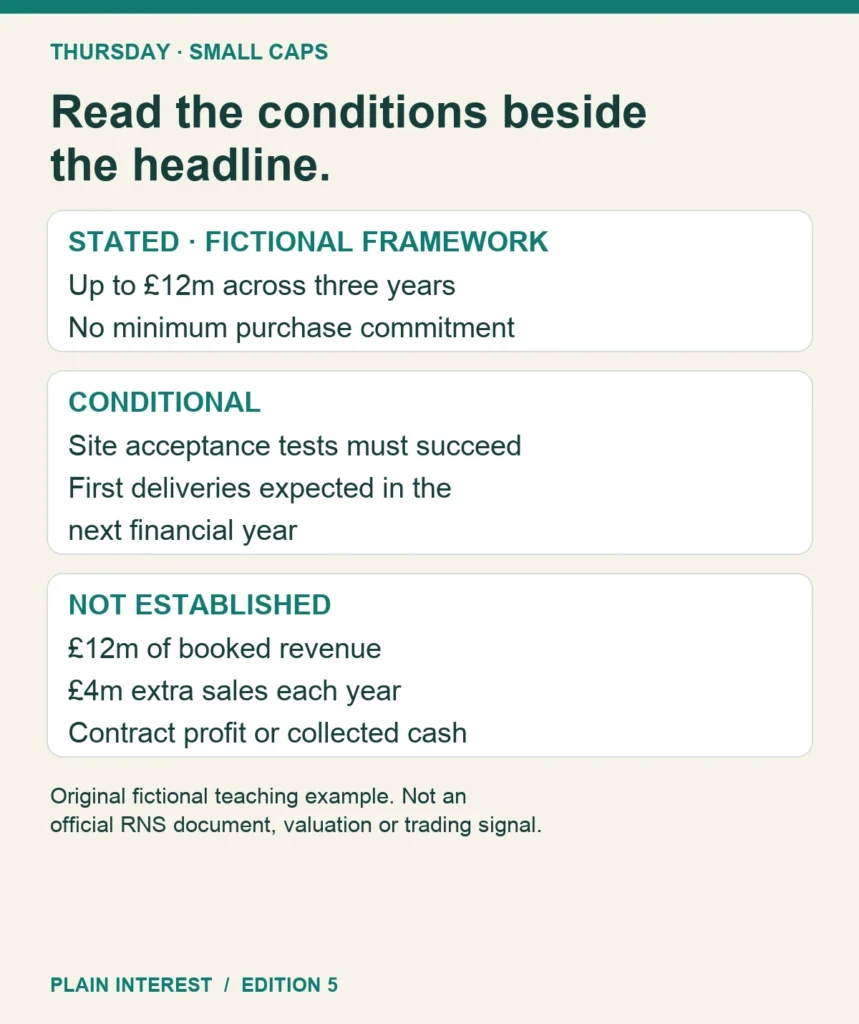
Fictional teaching extract: Northbridge Sensors signs framework agreement worth up to £12 million.
The three-year agreement permits a customer to order monitoring equipment following site acceptance tests. It does not include a minimum purchase commitment. Management expects the first deliveries in the next financial year, subject to successful testing.
Revenue for the six months to 30 June was £4.8 million, compared with £4 million in the corresponding prior-year period. Adjusted operating profit was £0.6 million, excluding £0.8 million of restructuring and development-related charges. Statutory operating loss was £0.2 million.
Cash at 30 June was £1.1 million, compared with £2 million at 31 December. The group received £0.5 million of new equity funding during the six-month period. Management expects full-year trading to be in line with its expectations. No numerical full-year forecast or contract margin is provided in this extract.
There is potentially useful progress here. But treating £12 million as booked revenue or cash in the bank would replace the actual wording with a much stronger claim. The conditions belong beside the number every time you interpret it.
Separate a ceiling from a commitment
“Up to £12 million” is a maximum under the described framework. With no minimum purchase commitment, the extract does not establish how much will actually be ordered. Successful testing is another condition. First deliveries are expected, not confirmed, and they fall in the next financial year.
Dividing £12 million by three gives £4 million per year arithmetically. It does not produce a supported annual revenue forecast. That would assume the full ceiling is used and purchases are evenly spread. Neither assumption appears in the extract.
A useful note therefore reads: “Potential three-year order ceiling £12 million; no minimum; testing required; timing uncertain.” An unhelpful note reads: “£4 million extra annual sales.” The shorter second note is more definite only because it has discarded the evidence.
Even a firm order is not automatically recognised revenue, profit or collected cash. Under International Financial Reporting Standard 15, or IFRS 15, revenue recognition follows satisfaction of obligations to transfer goods or services, with detailed rules for timing. A company’s accounting policy and contract terms matter. Use its financial statements to establish how the relevant revenue is recognised.
Put the comparison period beside the growth claim
Revenue rose from £4 million to £4.8 million in our six-month comparison. The increase is £0.8 million; dividing by the prior £4 million gives 20%. That supports a 20% year-on-year increase for that half-year period.
It does not establish 20% full-year growth, 20% organic growth or 20% volume growth. Organic growth normally attempts to exclude effects such as acquisitions, but definitions differ. Currency changes, pricing and business purchases can all complicate the interpretation of reported sales growth.
Our extract does not explain the drivers, so record them as unknown. Do not claim an acquisition distorted the number when no acquisition is mentioned. Equally, do not silently assume there was none. A good evidence note distinguishes an unanswered question from an adverse finding.
For a real issuer, compare the same period, currency, business scope and accounting basis. If the presentation changed, look for a reconciliation or restated comparison. Two accurate figures can still make a misleading comparison when their definitions differ.
Read adjusted and statutory numbers together
Northbridge reports £0.6 million adjusted operating profit but a £0.2 million statutory operating loss. The stated £0.8 million excluded charges reconcile the difference: £0.6 million minus £0.8 million equals minus £0.2 million.
That reconciliation is the beginning of the analysis. What makes up the excluded charges? Which involve cash? Have comparable adjustments appeared repeatedly? Does the company’s explanation support using the adjusted measure for the particular question being asked?
It is too crude to call every adjustment deceptive. It is equally unhelpful to treat an adjusted profit as though the statutory loss does not exist. Both numbers can be accurate while emphasising different aspects of the same business.
The extract gives no contract margin, so the £12 million headline cannot be converted into a profit contribution. Revenue says something about sales activity; profit also requires costs. Neither tells you by itself when the customer pays.
A cash balance is a dated stock, not a runway forecast
Cash fell from £2 million at 31 December to £1.1 million at 30 June, a net decline of £0.9 million. The company also received £0.5 million of equity funding. If those are the only financing inflows and we ignore exchange effects for this exercise, other net cash movements total minus £1.4 million.
That is not enough information to label £1.4 million as operating cash burn. It could include investment, debt repayment or other movements. Nor does £1.1 million divided by a past monthly average establish when the company will run out of cash. Timing, restricted balances, future receipts and commitments matter.
The appropriate next document is the cash-flow statement and its notes, alongside the financing terms. Because new shares can change each existing holder’s proportional ownership, the share-dilution lesson is a useful foundation for that part of the announcement.
Whose expectations are being met?
“In line with management expectations” does not reveal a numerical forecast unless the company supplies one or points to a clearly identified earlier statement. It is not automatically the same as meeting analyst consensus or the expectations reflected in the share price.
Our extract gives no figure, so the reader cannot calculate forecast headroom. That uncertainty should remain visible. The earlier explanation of market price and value helps explain why a favourable business development need not produce a favourable price reaction.
Use one evidence card, without a score
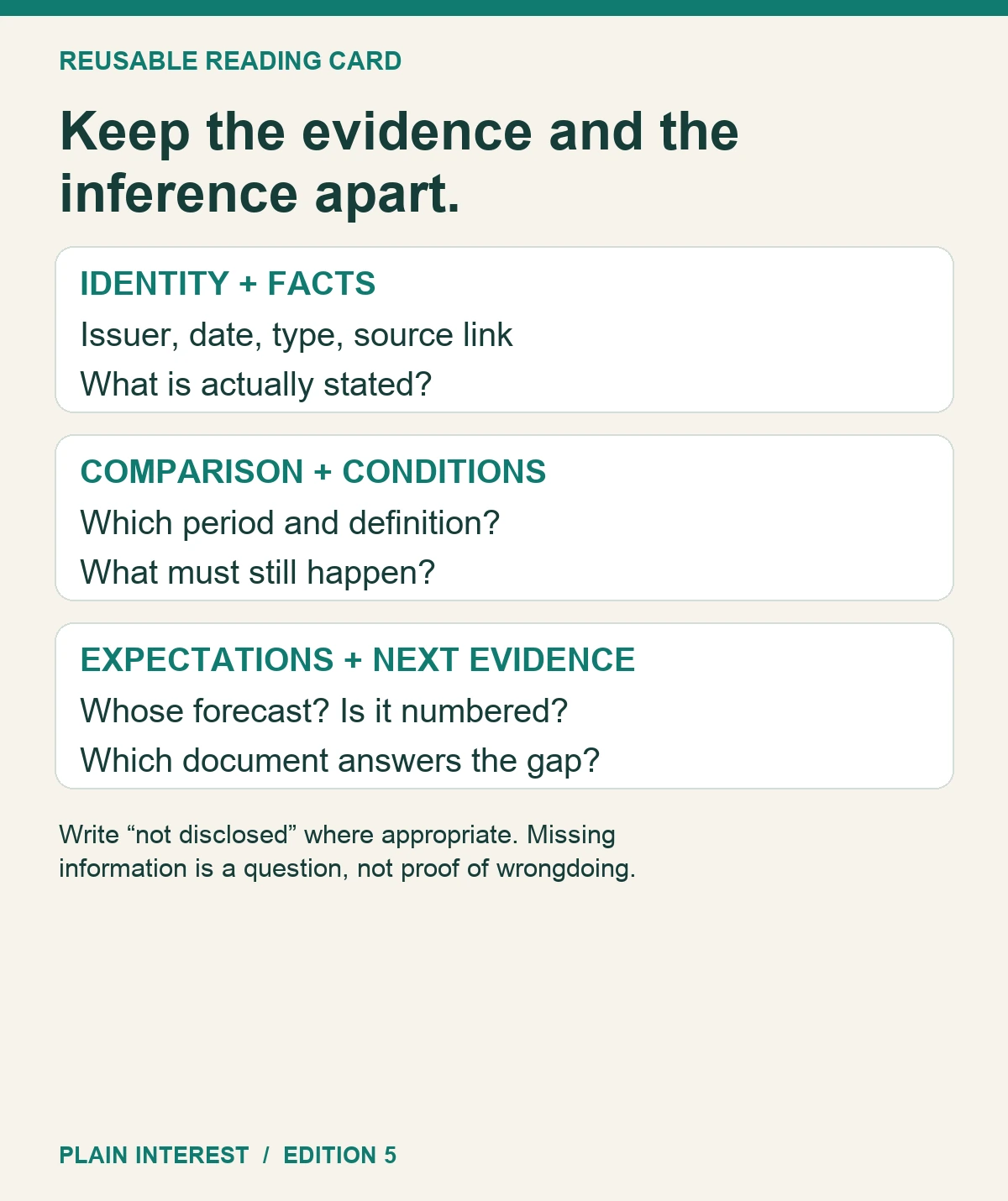
For the announcement in front of you, record these six fields:
- Identity: issuer, original release link, date, announcement type and reporting period.
- Established facts: the figures or events actually stated, with their definitions.
- Comparison: prior period, currency and business scope; reproduce important arithmetic.
- Conditions: approvals, testing, customer choices, funding needs and timing assumptions.
- Expectations: whose forecast, what number and which period, or “not disclosed”.
- Next evidence: the specific report, note or later milestone that would answer the remaining question.
The card is a reusable reading aid, not a red-flag score or trading signal. Its value is preserving the difference between a fact, a condition and your inference. Finish with a sentence you can defend from the release. For Northbridge: “Sales grew, but the new framework has no minimum orders, and cash and profit need separate examination.”