Plain answer
When comparable market yields rise, an existing bond’s fixed payments become less attractive, so its market price normally falls until the overall return is competitive. The reverse usually happens when yields fall, but maturity, coupon and cash-flow timing mean bonds do not all move by the same amount.
A conventional gilt can promise exactly the same cash payments tomorrow as it did yesterday and still fall in price today. Nothing has broken in the promise. What changed is the return available elsewhere.
That is the key to the often confusing relationship between bond prices and interest rates. The bond’s fixed cash flows are compared with current market opportunities, so its tradable price adjusts.
Financial markets allow existing investments to change hands. If that role is unfamiliar, first read why financial markets exist. A bond price is the amount buyers and sellers agree today for a defined stream of future payments.
First separate four different numbers
Coupon
The coupon is the contractual interest payment. A conventional UK government bond, or gilt, normally pays a fixed coupon every six months and repays its face value at maturity. A gilt with £100 face value and a 2% annual coupon pays £2 a year, commonly as two £1 instalments.
Market price
The market price is what somebody pays for the bond now. It can be above or below the £100 face value. Buying below £100 does not reduce the contractual £100 repayment, assuming the issuer pays as promised; it changes what the buyer pays to receive it.
Current yield
The current yield divides the annual coupon by the current market price. A £2 coupon on a £100 price gives 2%. On a £94.40 price it is about 2.12%. This measure ignores the capital gain or loss between the purchase price and the £100 repayment, so it is incomplete.
Yield to maturity
The yield to maturity is the single annualised discount rate that makes the present value of the remaining coupons and redemption payment equal the market price, under stated conventions and assuming payments are made. It incorporates both income and the pull towards the redemption value. It is not a guaranteed personal return: reinvestment, tax, dealing costs, default and an early sale can change the outcome.
Why the price has to move
Imagine an existing gilt pays £2 a year on £100 face value. Now suppose newly available, comparable government bonds offer a market yield of about 4%. A buyer would not normally pay £100 for the old 2% coupon stream if £100 can buy a more attractive new stream with similar risk and timing.
The old bond can still compete if its price falls. The buyer pays less now, continues to receive the fixed £2 annual coupon and, if holding to maturity, receives £100 at redemption. The combination of coupons and the difference between purchase price and redemption value raises the yield to maturity towards the new market level.
This does not mean a central-bank policy rate and every bond yield move one-for-one. “Interest rates” is loose shorthand. The relevant comparison depends on maturity, credit risk, liquidity and expectations. The direction is easiest to see when everything except the market yield is held constant.
Two fictional £100 gilts
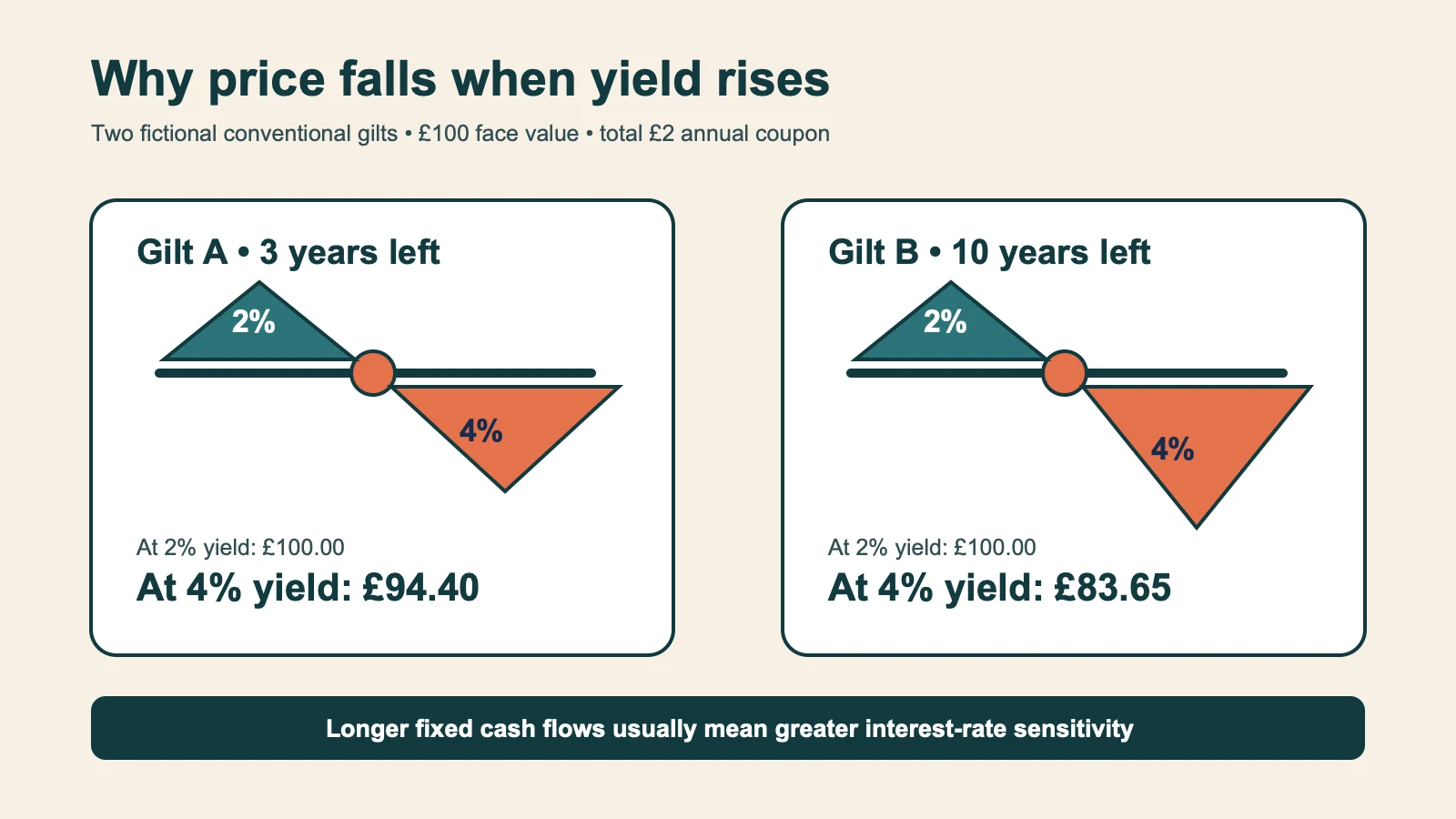
Take two simplified conventional gilts. Each has £100 face value, pays £1 every six months and repays £100 at maturity. Gilt A has three years left, so it has six coupon payments. Gilt B has ten years left, so it has 20.
At a 2% annual yield with semi-annual compounding, each is priced at £100 in this simplified example. At a 4% annual yield, each £1 coupon and the £100 redemption payment are discounted at 2% for every remaining six-month period.
| Fictional gilt | Cash flows left | Price at 2% yield | Price at 4% yield | Fall |
|---|---|---|---|---|
| A: three years | Six £1 coupons, then £100 | £100.00 | £94.40 | 5.60% |
| B: ten years | Twenty £1 coupons, then £100 | £100.00 | £83.65 | 16.35% |
The three-year calculation is £1 divided by 1.02 for the first half-year, plus £1 divided by 1.02 squared for the second, continuing through six periods, with £100 also discounted for six periods. That totals about £94.3986. Repeating the same process for 20 periods gives about £83.6486.
The exact prices do not establish a universal rule that a two-percentage-point yield rise causes either fall. They depend on the chosen coupon, maturity, payment frequency and yield convention. Their purpose is to isolate why time changes sensitivity.
Why the longer gilt moves more
Most of Gilt B’s value arrives further in the future. A higher discount rate is applied repeatedly across more periods, so the present value falls more. This exposure is called interest-rate sensitivity. Duration is a commonly used measure of it, but the intuition comes first: cash received later is more affected by a change in the rate used to value it.
A lower coupon usually also increases sensitivity, other things equal, because more of the bond’s value is concentrated in the final repayment. Higher coupons return more cash sooner. Embedded options, inflation linkage and credit risk can add further complications.
What happens if yields fall?
The mechanism works in reverse. If comparable market yields fall below the old bond’s coupon rate, its fixed payments become more attractive and buyers may pay more than £100. Paying a premium reduces the yield because the buyer still receives only the specified coupons and £100 redemption payment.
Price and yield therefore move in opposite directions for a conventional fixed-rate bond when its cash flows are held constant. “Normally” matters: a bond’s credit outlook, liquidity or terms can change at the same time and overwhelm the interest-rate effect.
Holding to maturity does not erase the constraint
A holder who receives every promised payment and keeps the gilt to maturity may not need to realise the interim market fall. But the lower price still measures an opportunity cost: newer bonds offer a higher return, while the existing holder remains tied to the old cash flows.
The price also matters if circumstances force a sale. That connects Tuesday to Monday. A long-term asset can be doing exactly what its contract says while still producing an inconvenient sale price when cash is needed.
A five-question bond check
- What are the remaining coupon and redemption cash flows?
- Is the quoted number a coupon, current yield or yield to maturity?
- How long is left until the main cash flows arrive?
- Which market yield is genuinely comparable for maturity and risk?
- Could the bond need to be sold before maturity?
Those questions are more useful than memorising “rates up, bonds down”. They reveal which rate matters, what the price represents and why one bond can move much more than another.
Two quotation details that can confuse the comparison
First, gilts are commonly discussed using a clean price, which excludes accrued or rebate interest. A buyer’s settlement amount combines that clean price with accrued interest or, during an ex-dividend period, rebate interest. Accrued interest is typically added when the buyer will receive the next coupon; rebate interest is typically deducted when the seller retains it. The simplified prices in this article are clean teaching figures. They are designed to expose the yield effect, not reproduce a broker contract note.
Second, the Bank of England’s policy rate is not the yield on every gilt. Longer-dated yields reflect expectations about future short-term rates as well as inflation, supply, demand and term compensation. A policy-rate announcement can move gilt prices, but the calculation uses the comparable market yield for the bond’s cash-flow dates. That is why a headline rate rise and a particular gilt-price move will rarely form an exact formula.
These details do not weaken the core relationship. They explain why a real quotation can differ from a classroom example even when the inverse price/yield logic is working exactly as expected.
The useful conclusion
A fixed coupon does not mean a fixed market value. When the return available on comparable new bonds changes, the price of the old cash-flow stream adjusts. The longer and more back-loaded that stream is, the more sensitive it will usually be.
Next comes a different price constraint: even after a trading instruction is triggered, the price at which it can execute may still be outside the trader’s control.