Plain answer
A cryptoasset is a digital representation of value or rights that can be stored or transferred electronically and is secured using cryptography. Its price is set by supply and demand; usefulness, credible scarcity, rights, backing and trust may support demand, but none guarantees lasting value.
What does “cryptoasset” actually mean?
“Cryptoasset” is the useful umbrella term. It covers digital assets commonly called coins or tokens, but they do not all work in the same way or give their holders the same rights.
The UK Financial Conduct Authority’s definition, used in the rules for qualifying cryptoasset promotions, describes a cryptoasset as a cryptographically secured digital representation of value or contractual rights that can be transferred, stored or traded electronically. It must use technology that records or stores data, which may include distributed ledger technology.
That definition is deliberately broad. In plain English, a cryptoasset is an electronic asset whose ownership or control is represented by data and protected using cryptography: mathematical techniques for securing information and proving that an authorised party approved a transaction.
Many cryptoassets are recorded on a blockchain: a ledger in which transactions are grouped into blocks and linked in order. Copies may be maintained by many computers, which follow agreed rules to decide which transactions are valid. Bitcoin uses this model so participants can agree on a history without a bank running the ledger. Its design makes altering old records progressively harder. “Tamper-resistant” is more accurate than “impossible to alter”.
But decentralisation is not a condition shared equally by every cryptoasset. Some networks have many independent validators. Others depend heavily on a company, foundation, small developer group or restricted set of operators. Some tokens are issued and administered by an identifiable business. The label “cryptoasset” does not, by itself, prove that control is widely distributed or that nobody can change the rules.
Plain English definition
Validator
A computer or operator that checks transactions against a network’s rules and helps the network agree on the ledger’s valid state. The exact process varies between networks.
What do you own when you own a cryptoasset?
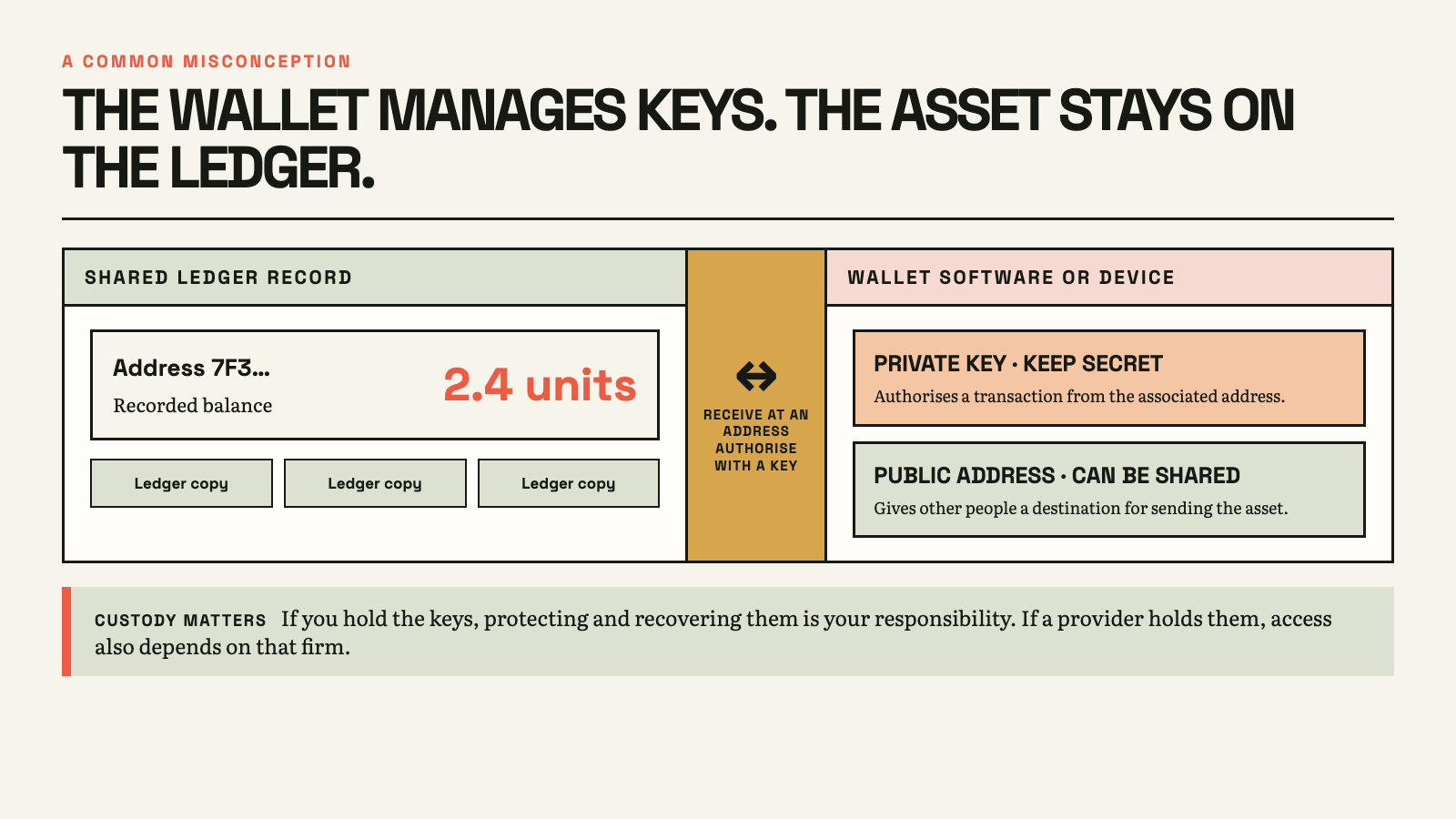
Usually, the asset does not sit inside a wallet in the way a £10 note sits in a purse. The ledger records units against an address. A wallet manages the cryptographic keys used to authorise transactions from that address.
A private key is secret information that gives its controller the practical ability to move the associated cryptoasset. A public address is the destination other people can use when sending assets. This distinction matters because controlling a token is not always the same as owning a conventional financial claim.
A share represents an ownership interest in a company; a bond is an issuer’s contractual promise. A cryptoasset may instead give you network access, voting powers, redemption rights, a claim against an issuer, or no enforceable right beyond transferring the token. You have to inspect the asset and its terms.
Custody changes what you control. Holding your own keys makes you responsible for protecting and recovering them. If an exchange or custodian controls them, access also depends on that firm’s systems, solvency and terms. A secure blockchain cannot prevent losses caused by stolen credentials, mistaken transfers, fraud or a failed intermediary.
Cryptoasset and cryptocurrency are not exact synonyms
“Cryptocurrency” suggests a digital asset intended to work as money. Bitcoin was proposed as peer-to-peer electronic cash, although people also hold it speculatively. “Cryptoasset” also covers network-fee or access tokens, stablecoins intended to track another asset, and non-fungible tokens identifying a unique item or record. Calling all of these currencies hides important differences.
Purpose: compare broad cryptoasset types before considering how each might derive demand or rights.
Four broad types of cryptoasset
| Broad type | Intended role | Possible source of demand | Important limitation |
|---|---|---|---|
| Native coin, such as bitcoin | Transfer value and operate its network | Payments, holding or speculation | No claim on profits or redemption |
| Network or application token | Pay fees, access a service or vote | Use of the network or application | A useful network does not automatically make its token valuable |
| Stablecoin | Seek a stable price against a reference asset | Payments, trading and settlement | Depends on its design, backing, redemption and issuer |
| Non-fungible or ownership-style token | Identify a unique item or specified rights | Collecting, access or use | Does not automatically transfer copyright or legal title |
These are explanatory categories, not legal classifications, and real designs can overlap. One valuation story cannot sensibly cover every cryptoasset.
Text equivalent: native coins may transfer value without giving profit or redemption rights; network tokens may pay fees or provide access without capturing the network’s value; stablecoins depend on backing, redemption and issuer arrangements; and non-fungible or ownership-style tokens do not automatically transfer copyright or legal title.
What gives a cryptoasset value?
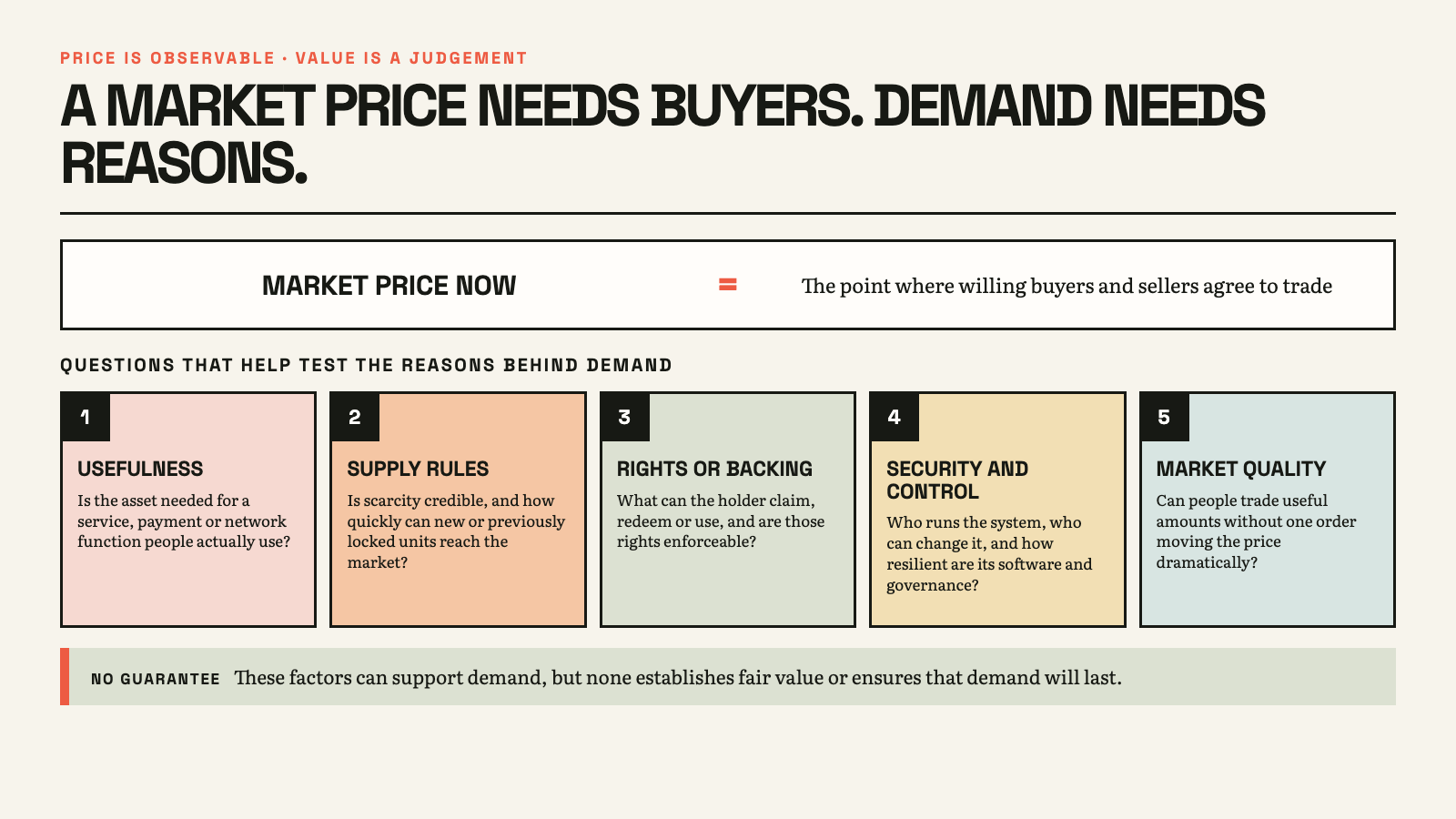
The immediate answer is supply and demand. A market price exists when buyers and sellers agree to exchange an asset. If willing buyers become more numerous or more aggressive while the amount offered for sale stays the same, the price can rise. If demand falls or sellers rush for the exit, the price can fall.
That explains how a price changes, but not why anyone wants the asset in the first place. For that, six questions are more useful.
1. Is there real demand?
Demand may come from people who want to use a network, make payments, transfer funds, hold the asset for the long term or trade it for a short-term profit. These motives are not equivalent.
Repeated use may support demand more durably than advertising or social-media attention. Even then, the token must be needed and its design must connect use of the service to demand for it. Speculation can create a real market price without establishing dependable value: buyers may simply expect somebody else to pay more later.
2. What happens to supply?
Scarcity can matter only when demand exists. Bitcoin’s validation rules enforce a maximum of 21 million bitcoin, and new issuance follows a predetermined declining schedule. That makes its eventual supply more predictable than the supply of many other assets.
It does not make a price increase inevitable. A limited edition of something nobody wants is still unwanted. Scarcity supports price only when enough people also value the asset’s other properties.
Other assets may issue units to validators, release them to early investors, destroy them through a “burn”, or unlock them on a schedule. A quoted maximum can mislead if insiders control much of the supply or large amounts become tradeable later. Ask who owns it, who can change the rules and how quickly more units can reach the market.
3. Is the asset useful, and is the token necessary?
Some assets have a functional role. Ether, for example, is required to pay transaction fees on Ethereum and is staked by validators who help secure the network. This creates a connection between use of the network and demand for ETH.
Utility is not a magic word. Promised uses may not be built, adopted or require the token. Even a useful service may create value for users or developers rather than token holders. Ask: “Why must somebody obtain or hold this asset to use the service?”
4. What, if anything, supports or backs it?
Many cryptoassets, including Bitcoin, do not give the holder a claim on a pool of conventional assets or a company’s cash flows. Their price depends largely on demand for the asset’s own properties and confidence that the network will keep functioning as expected.
Some assets are different. A stablecoin may hold reserves and offer redemption at a target value; another token may refer to a real-world asset or contractual right. Value then depends on the issuer, custody, legal terms, redemption and enforceability. Ask what the reserves are, who owns them and what happens if the issuer fails. A peg is an objective, not a guarantee.
5. Can people trust the system and its rules?
Trust in crypto does not disappear; it moves. On a decentralised network, users may rely less on one bank but more on software, economic incentives, validators, developers and governance rules. They also rely on wallets, exchanges and other services used to access the network.
Transparent rules, independently run infrastructure, tested software and credible security can strengthen confidence. Coding flaws, concentrated control, unclear governance, outages or dishonest promoters can weaken it. More users and supporting services may make an asset more useful, but popularity is not proof of safety or fair value.
6. Is there a functioning, liquid market?
Liquidity means being able to buy or sell without the trade itself moving the price dramatically. A token can display a high quoted price while very little is actually available to trade. In a thin market, one large order can cause a sharp move, and a holder may be unable to sell near the last displayed price.
Market quality also depends on where trading occurs, concentrated ownership and whether activity is genuine. “Market capitalisation”, the latest price multiplied by token supply, does not prove that every token could be sold for that total.
Why can cryptoasset prices move so sharply?
Established shares can be difficult to value, but investors can examine a company’s revenue, costs, assets, debts and expected cash flows. Bonds have promised payments, subject to the issuer being able to make them. Many unbacked cryptoassets have no comparable cash flow or redemption value to anchor estimates.
That leaves more room for competing stories about future adoption. Prices can react sharply to changing sentiment, regulation, security incidents, influential online posts, exchange failures or changes to a network. Trading takes place across multiple venues, and liquidity can disappear just when many holders want to sell.
The FCA describes cryptoassets as high-risk and says most remain highly speculative even as the UK regulatory regime develops. It warns that buyers should be prepared to lose the entire value of an investment. Regulation of promotions or service providers should not be mistaken for a guarantee that an asset is sound, suitable or protected against market loss.
Current UK position · checked 21 August 2026
The broader regime is not yet fully in force
The FCA published its final policy statements in June 2026, but the full scope of newly regulated cryptoasset activities is expected to expand from 25 October 2027. Protection still depends on the asset, firm and activity, and it does not cover ordinary market losses.
Illustrative status: fictional tokens and general education, not a recommendation to buy, sell or hold a cryptoasset.
In practice: scarcity is not enough
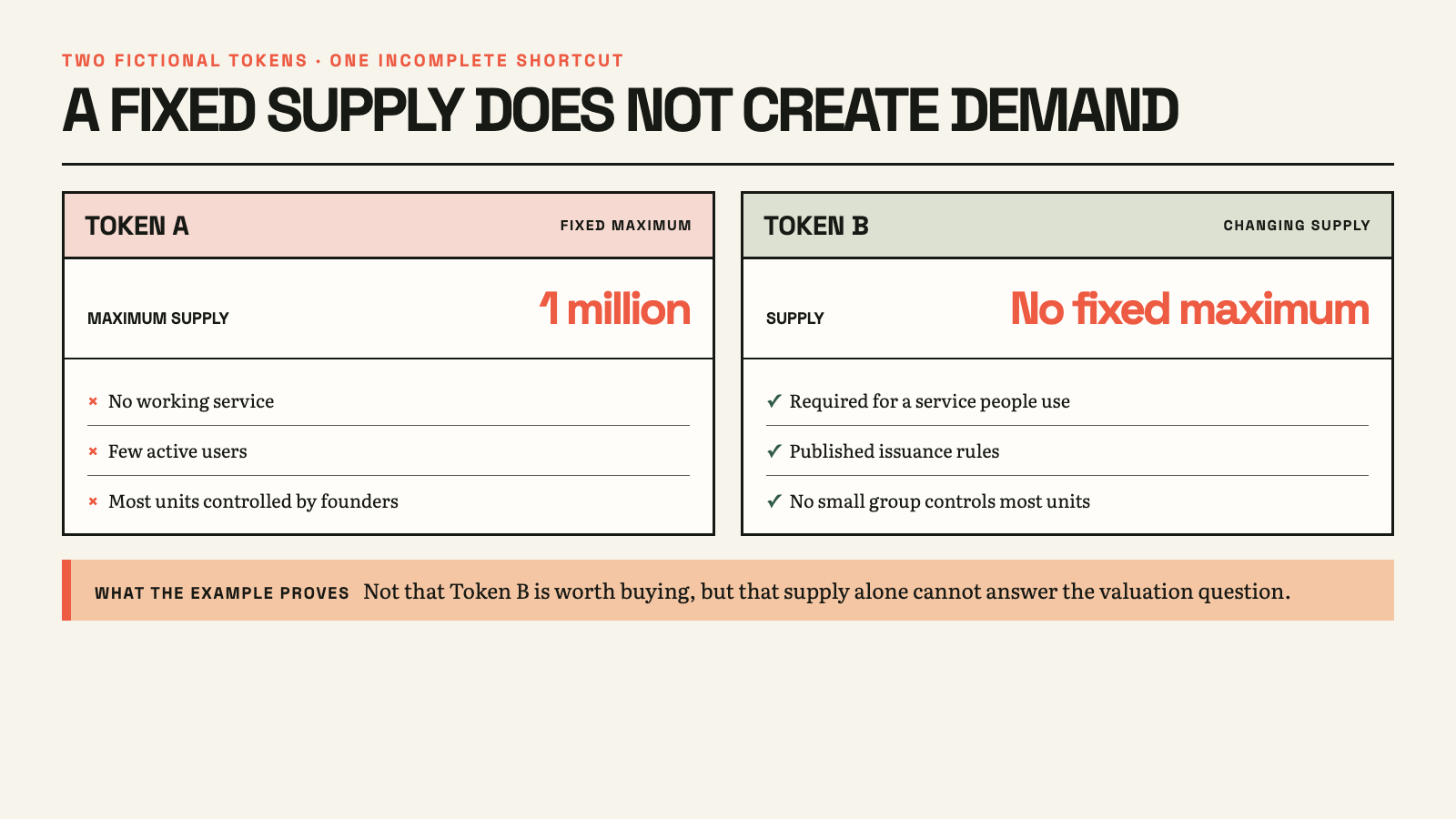
Imagine two fictional tokens. Token A has a fixed supply of one million units, but no working service, few users and most units are controlled by its founders. Token B has no fixed maximum, but is required to pay for a service that people use regularly; its published rules explain issuance and no small group controls most of the supply.
This illustration does not establish that Token B is worth buying or that Token A must fail. It shows why “limited supply” cannot answer the valuation question on its own. Demand, usefulness, distribution, governance, security and market liquidity all affect the picture. The figures and tokens are entirely illustrative, not live market data or a forecast.
Questions to ask before treating a cryptoasset as valuable
Start with the asset, not its price chart:
- What is it for? Identify a present function, not only a promised future use.
- What does the token holder receive? Look for access, voting powers, redemption rights or an enforceable claim. Do not assume rights that are not written down.
- Why is this token necessary? Separate a useful technology from the economic case for its token.
- How does supply change? Check current circulation, future issuance, token unlocks, concentration and who can alter the rules.
- Who controls the network or issuer? “Decentralised” should be tested against the actual distribution of validators, developers, voting power and administration.
- What could break confidence? Consider software failures, governance disputes, loss of a peg, regulation, competition and waning demand.
- Can you buy, hold and sell it safely? Examine liquidity, custody, counterparty risk, fees and the consequences of losing access to your keys.
- What protections apply? UK cryptoasset activities are moving into a broader regulatory regime, but protection varies by asset, firm and activity. Do not assume Financial Services Compensation Scheme or Financial Ombudsman Service cover.
These questions will not produce one precise “correct” value. They can expose when a price rests mainly on a story, and when important risks or rights are being left unexplained.
Practical takeaways
- A cryptoasset is a broad category, not a promise that an asset is decentralised, useful or valuable.
- Market price comes from supply and demand; durable demand may depend on utility, credible scarcity, rights, backing, security and adoption.
- Scarcity without demand does not create value, and usefulness of a network does not automatically create value for its token.
- Different assets need different tests. An unbacked coin, a fee token, a stablecoin and an ownership-style token do not have the same valuation logic or risks.
- The blockchain may be secure while the holder still loses money through price falls, fraud, failed custody, stolen keys or an issuer’s failure.
- A high price or market capitalisation shows what the latest market accepted. It does not prove fair value, safety or future returns.
The simplest useful conclusion is that a cryptoasset is valuable only while people have a reason to demand it and confidence that the system, rights or backing they rely on will hold. Those reasons can be strong, weak or temporary. Understanding which kind you are looking at matters more than the label “crypto”.
Evidence · Enhanced
| Claim | Checked sources |
|---|---|
| FCA definition of a qualifying cryptoasset | Financial Conduct Authority — FCA Handbook Glossary: qualifying cryptoasset (checked 2026-08-21) |
| The FCA published final policy statements in June 2026 and the full scope of regulated activities is expected to expand from 25 October 2027 | Financial Conduct Authority — Overview of our cryptoassets regime policy statements (checked 2026-08-21) |
| Cryptoassets are high risk and FSCS or FOS protection should not be assumed | Financial Conduct Authority — Investing in crypto (checked 2026-08-21) |
| Bitcoin can maintain a transaction history without a bank and has a maximum supply of 21 million |
Bitcoin.org — Bitcoin: A Peer-to-Peer Electronic Cash System (checked 2026-08-21) Bitcoin.org — Frequently asked questions (checked 2026-08-21) |
| Ether is required for Ethereum transaction fees and validator activity | Ethereum.org — Technical introduction to ether (checked 2026-08-21) |
| Stablecoin value depends on backing, issuer and redemption arrangements | Bank of England — What are stablecoins and how do they work? (checked 2026-08-21) |