Plain answer
Both ISAs provide a tax framework, but the assets inside and the access terms determine how the money behaves. A Cash ISA normally holds deposits; a Stocks and Shares ISA holds eligible investments whose values can fall. Check the relevant protection rather than assuming the ISA label guarantees capital.
A Cash ISA and a Stocks and Shares ISA solve the same tax problem but can hold very different things. That is why comparing them only by the letters on the account is misleading. One may contain a bank deposit; the other may contain shares, bonds or investment funds whose prices change.
Start with three questions: what is inside, when can the money be reached, and what could make its value fall? The tax treatment matters, but it cannot answer those questions for you. If the underlying distinction is unfamiliar, first read saving, investing and trading explained.
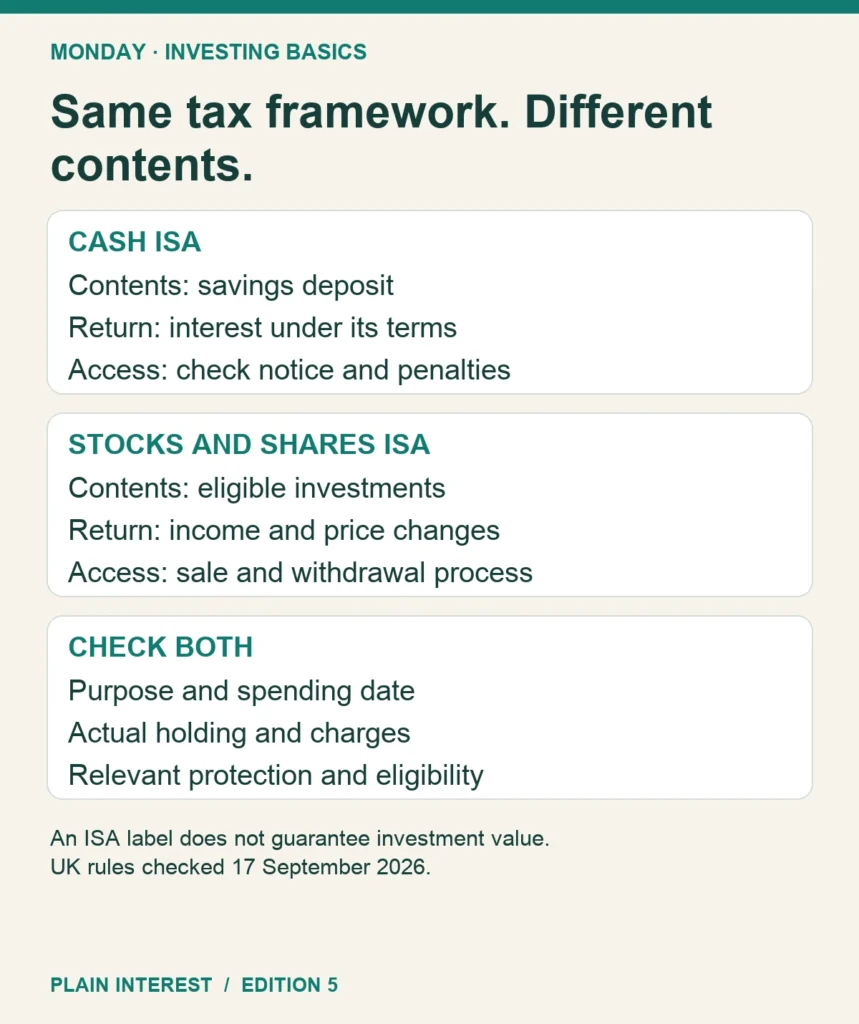
The account is a container; the contents do the work
ISA stands for Individual Savings Account. Think of it as a labelled container with tax rules attached. The container changes how eligible interest, investment income and capital gains are treated for UK tax. It does not turn everything placed inside into the same kind of asset.
A Cash ISA normally holds savings with a bank or building society and pays interest. A Stocks and Shares ISA can hold eligible investments such as company shares, investment funds and bonds. Despite its name, it need not consist entirely of individual shares. Nor does opening one necessarily mean that money has already been invested: a provider may initially hold a cash balance.
Imagine two identical storage boxes. One contains tins; the other contains seedlings. The labels on the boxes might give them the same storage entitlement, but the contents behave differently. With ISAs, it is the contents that determine most investment risk and potential return.
What the tax rules say now
For the 2026/27 tax year, running from 6 April 2026 to 5 April 2027, the overall adult ISA subscription allowance is £20,000. A subscription is new money paid in. This is one shared allowance across the relevant ISA types, not £20,000 for each account.
For example, someone paying £8,000 into a Cash ISA and £7,000 into a Stocks and Shares ISA has used £15,000, leaving £5,000 of that year’s overall allowance, assuming no other subscriptions. Existing balances from earlier years do not use the new year’s allowance merely by remaining invested. Investment growth is not an additional subscription either.
Eligible ISA interest, income and capital gains do not attract UK Income Tax or Capital Gains Tax within the account. Tax relief does not cancel charges, inflation or investment losses. It also does not mean every tax connected with buying or holding an asset disappears.
The government has announced a £12,000 annual Cash ISA subscription limit for under-65s from 6 April 2027, within the £20,000 overall allowance. That is a future change, not the Cash ISA limit for 2026/27. Check the current rules when paying in rather than applying a headline about next year to this year’s decision.
How the money can grow, or lose purchasing power
With a Cash ISA, the return comes from interest under the account’s terms. A variable rate can change. A fixed rate normally applies for a stated period, alongside conditions on access. A quoted rate therefore needs to be read together with the period, withdrawal rules and any temporary bonus.
A bank deposit generally avoids the day-to-day market-price movements of shares. But a stable number of pounds does not guarantee stable purchasing power. If prices rise faster than the account’s interest, the money buys less even though the balance has increased.
With a Stocks and Shares ISA, the outcome depends on the investments held. They may pay dividends or interest, and their market values can rise or fall. Charges also affect the result. A diversified fund, a single small company and a bond fund are different exposures even when held with the same ISA provider.
A longer time horizon can make it more practical to tolerate temporary falls, but it does not promise recovery by a particular date. “Long term” is a description of a plan, not insurance against losing money.
Compare two purposes before comparing two accounts
Consider two fictional £6,000 pots. Rowan expects to use the first for essential work on a home in nine months. The second has no fixed spending date and is intended for a much later goal. The amounts match; the jobs do not.
For the first pot, Rowan needs to know whether the money will be available on time and whether the required sum could be smaller when the bill arrives. An attractive possible investment return does not solve the problem of a market fall immediately before payment. The access conditions of a Cash ISA still need checking: fixed-term does not mean instant access.
For the second pot, Rowan can examine whether taking investment risk suits the goal and the wider financial position. That examination includes the ability to tolerate losses, not just willingness to see a fluctuating balance. A person can feel comfortable with risk yet lack enough accessible cash to leave investments alone.
Here is simple arithmetic, not a forecast. At a fictional 4% annual interest rate, £6,000 held for a full year becomes £6,240, assuming that rate applies throughout and no withdrawals. An investment rising 8% becomes £6,480 before charges; one falling 15% becomes £5,100. Those investment outcomes are illustrative possibilities, not a likely range or a prediction.
The relevant comparison is not “£6,480 beats £6,240”. It is whether the purpose can withstand the £5,100 outcome, the costs and the uncertainty. The cash-before-investing lesson explains how to separate accessible reserves from money intended for longer-term investment.
Access has more than one meaning
Being allowed to request a withdrawal is different from receiving the required amount immediately. A Cash ISA may impose notice, an interest penalty or other restrictions. A Stocks and Shares ISA may require an investment sale, settlement and a withdrawal to a bank account. The market price available when selling is another part of access.
Some ISAs are flexible: qualifying withdrawals can be replaced under the flexibility rules without using further annual allowance. Others are not. Do not infer flexibility from a provider’s name or from the fact that an app has a withdrawal button. Ask the provider how its particular account handles replacement payments and deadlines.
Moving an ISA between providers should normally use the receiving provider’s ISA transfer process. Withdrawing the money yourself and paying it into another account can use allowance again or lose the intended tax treatment. A transfer may also involve charges or time out of the market if investments must be sold rather than moved intact.
What does protection actually protect?
The Financial Services Compensation Scheme, or FSCS, can compensate eligible customers when certain authorised financial firms fail. It is not a promise that every financial product keeps its value.
Since 1 December 2025, eligible deposits with UK-authorised banks, building societies and credit unions have standard protection up to £120,000 per eligible person, per authorised firm. Cash ISA deposits count alongside other eligible deposits with the same firm. Two differently branded accounts may share one authorisation, so two logos do not automatically mean two limits.
Investment protection has different conditions. FSCS may cover an eligible investment claim against a failed authorised firm, normally up to £85,000 per eligible person per firm. It does not compensate ordinary poor investment performance. A falling fund price is not transformed into a covered claim because the fund sits in an ISA.
Cash temporarily held on an investment platform needs its own check: where is it held, with which bank, and under what arrangement? The account’s label alone does not establish how protection applies. Check the provider and the FSCS explanation for the actual holding.
Read the offer in a useful order
First state the money’s purpose and the earliest date it could be needed. Then identify the contents: a deposit, uninvested platform cash, or a particular investment. Read the access conditions, charges and relevant protection before treating the tax benefit as the deciding feature.
Finally, compare like with like. A cash rate and a fund’s past performance are different kinds of information; neither is a forecast of the other’s future. An ordinary savings account may also deserve comparison where savings interest would already fall within available tax allowances. The ISA label does not automatically make an offer the best available deal.
The next question is how the market measures used to describe investments are calculated. For this week, keep the first distinction clear: an ISA describes tax treatment; the contents and terms explain how the money behaves.
Evidence · Enhanced
| Claim | Checked sources |
|---|---|
| ISA contents, UK tax treatment and the shared £20,000 adult allowance for 2026/27 | GOV.UK — Individual Savings Accounts: How ISAs work (checked 2026-09-17) |
| The announced under-65 £12,000 Cash ISA limit starts 6 April 2027; it is not the current-year limit | HM Revenue & Customs — Cash Individual Savings Account limit reduction (checked 2026-09-17) |
| Access terms and qualifying flexible-ISA replacement rules | GOV.UK — Withdrawing your money (checked 2026-09-17) |
| Use the provider ISA-transfer process to preserve the intended treatment | GOV.UK — Transferring your ISA (checked 2026-09-17) |
| £120,000 standard eligible-deposit protection per person per authorised firm since 1 December 2025 | FSCS — Deposit protection limit (checked 2026-09-17) |
| Eligible investment compensation is normally up to £85,000 and excludes poor performance | FSCS — Investment compensation and protection (checked 2026-09-17) |