Plain answer
Investment fees cost you twice: the pounds paid and the compound growth those pounds can no longer earn.
A fee of 1% can sound harmless. It is only £1 in every £100, and it may look small beside a year in which an investment rises or falls by much more.
But the comparison is misleading. A market return is uncertain and changes from year to year. A fee is usually a known deduction that repeats. It reduces the balance today and removes money that could have earned returns in later years.
That is why the useful question is not simply, “What percentage is the fee?” It is: How many pounds will leave the investment, and what growth might those pounds no longer earn?
The plain-English answer
Investment fees create two costs:
- fees paid directly, which leave the account; and
- growth forgone, because the deducted money is no longer invested.
The second cost is not another charge from the provider. It is the mathematical consequence of having a smaller balance left to compound.
This does not mean the cheapest option is automatically the best. A service may justify a higher fee if it provides something genuinely valuable. It does mean that the extra value has to overcome a larger, predictable hurdle.
If the distinction between saving, investing and trading is still unclear, start with Plain Interest’s foundation guide. Fees matter in each activity, but they appear in different forms.

Which investment fees should you look for?
There is no single charging structure. Depending on the account and investment, the cost may include:
- a platform or account fee for providing the service;
- a fund charge for running an investment fund;
- an advice or management fee;
- dealing charges when buying or selling;
- transaction costs incurred inside a fund or at the point of trade;
- foreign-exchange charges when currencies are converted; and
- in some products, entry, exit or performance fees.
The labels matter less than the total effect. A platform that looks cheap on one headline percentage can become dearer after fixed dealing or foreign-exchange charges. A fixed annual fee can be expensive on a small balance and comparatively modest on a larger one.
Depending on the investment and service, applicable FCA rules require firms to disclose relevant one-off, ongoing and transaction costs, together with performance fees or carried interests where applicable, and to explain their effect on returns. That is a useful model for readers too: collect every layer before comparing alternatives.
Worked example: £10,000 invested for 20 years
Consider an illustrative £10,000 investment with no further contributions. Assume it earns exactly 5% before fees every year for 20 years. Compare two annual fee rates:
- Scenario A: 0.25% a year
- Scenario B: 1.00% a year
For simplicity, each year’s fee is deducted after that year’s 5% growth. Real investments do not produce a smooth return, providers calculate charges in different ways and tax is ignored. This is a teaching example, not a forecast.
| After 20 years | No annual fee | 0.25% annual fee | 1.00% annual fee |
|---|---|---|---|
| Ending balance | £26,532.98 | £25,237.37 | £21,701.51 |
| Fees paid in pounds | £0.00 | £844.29 | £3,110.53 |
| Growth forgone on deducted fees | £0.00 | £451.32 | £1,720.94 |
| Total gap versus no-fee balance | £0.00 | £1,295.61 | £4,831.47 |
The 1.00% scenario finishes about £3,535.86 below the 0.25% scenario. The fee-rate difference is only three-quarters of one percentage point, but it is applied repeatedly to a changing balance.
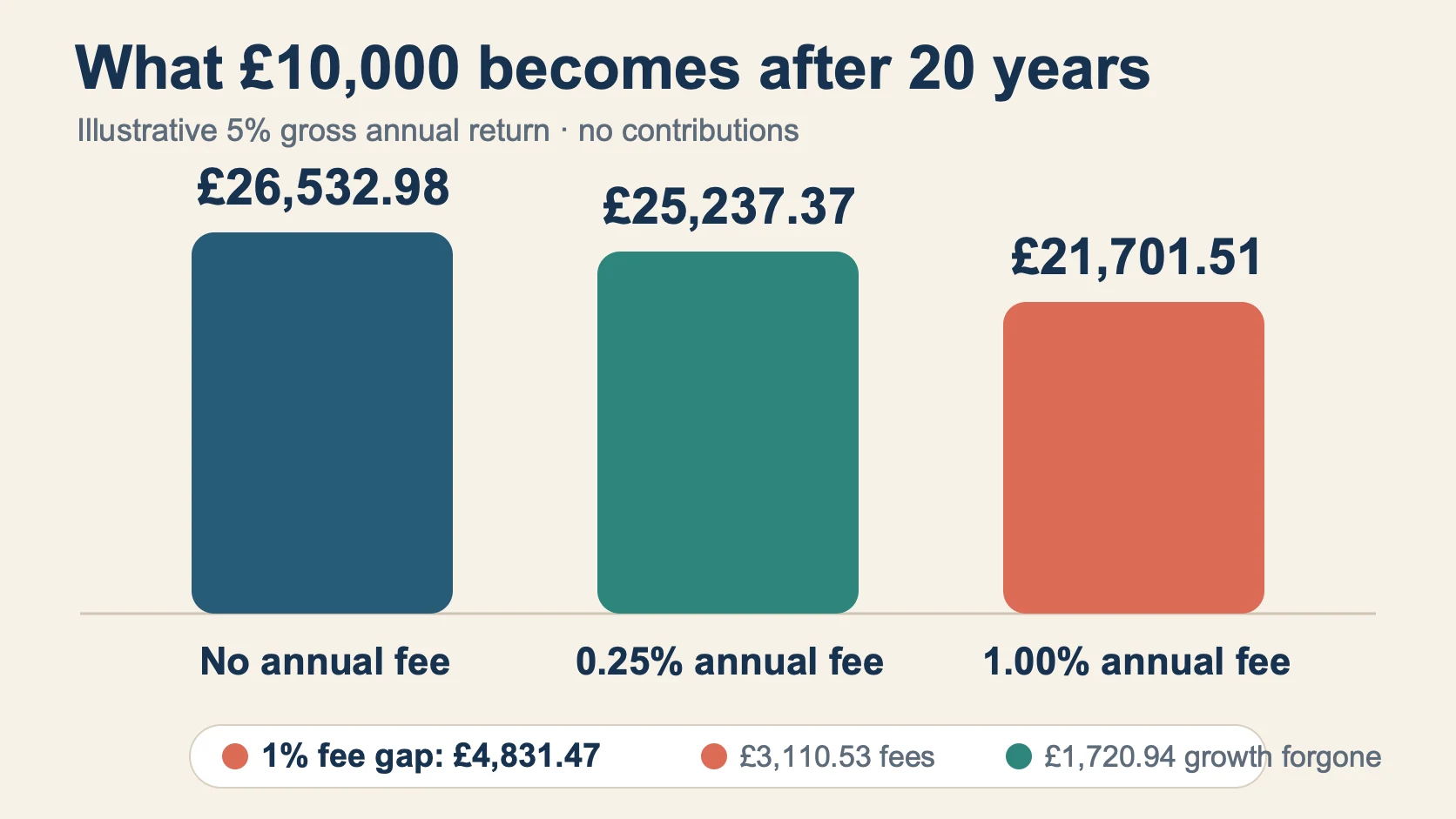
The chart separates what can otherwise look like one vague shortfall. In the 1.00% scenario, £3,110.53 was actually deducted. A further £1,720.94 is the growth those deductions might have earned under the example’s assumptions.
Why compounding works in both directions
Compounding means returns can build on earlier returns. If £10,000 rises by 5%, the next year begins with £10,500 rather than £10,000. Future growth is then calculated on the larger amount.
A recurring fee reverses part of that process. It reduces the base on which the next return is earned. The effect starts small, then becomes more visible as the years pass.
This is why multiplying the starting balance by the fee rate and then by 20 gives the wrong answer. It ignores the changing balance, the timing of deductions and the returns no longer earned.
It is also why a fee comparison needs a common basis. One provider may quote a percentage of assets, another a fixed cash amount and another a mixture. Convert them into estimated pounds for the balance and activity that are actually relevant.
Predictable costs are not the same as uncertain outcomes
Fees and returns should not be blended into one promise.
The fee rate is normally known in advance, subject to the provider’s terms changing. The fee schedule may be known even when the eventual cash amount is not, because balances, activity, transaction costs and performance can vary. The investment return is not. A fund that was expensive and performed well last year may perform badly next year. A cheap fund can also fall. Low cost reduces the hurdle; it does not remove investment risk.
Edition 2 explained why higher potential returns are usually linked to greater risk. Fees sit on a different side of the ledger: the outcome is uncertain, but the deduction is much more predictable.
That leads to a practical rule: do not justify a certain extra cost with an uncertain extra return unless the service and evidence make the trade-off clear.
A five-minute fee check
Before investing, ask:
- What will the platform or account cost at my likely balance?
- What does the investment itself charge?
- Are there dealing, foreign-exchange, entry or exit costs?
- Does the quoted figure include transaction costs or show them separately?
- Is any advice or discretionary management fee additional?
- What would the total first-year cost be in pounds?
- Which costs repeat, and which depend on how often I trade?
If two figures are calculated on different assumptions, they are not yet a comparison. Ask for the same investment amount, holding period and activity level.
When might a higher fee be reasonable?
A higher fee can pay for advice, tax planning, access, administration, a specialist strategy or a service that helps somebody avoid damaging decisions. The question is not whether all fees are bad. It is whether the benefit is clear, relevant and worth the recurring cost.
Be especially careful with a vague claim that a higher charge buys “better performance”. Performance cannot be promised merely because a product is dearer. Compare the service, risks and total cost, not the confidence of the marketing.
The useful conclusion
A headline return is not the return an investor keeps. Fees reduce it directly, and repeated deductions can also reduce future compound growth.
The best comparison converts percentages into pounds, includes every layer of cost and keeps assumptions visible. It then asks whether any higher fee buys a benefit that matters.
Next, move from a cost charged over years to a cost hidden inside a quote: why a new investment can start at a loss when there is a bid-offer spread.
Sources
- FCA DISC 6: Costs and charges information — cost categories and presentation requirements for consumer composite investments, including performance fees and carried interests where applicable.
- FCA COBS 6.1ZA: Costs and associated charges disclosure — aggregation and presentation requirements, including the cumulative effect of costs on returns.
- FCA: Investment platforms and consumers’ investment costs — good and poor practice in presenting platform costs.
- MoneyHelper: Popular investments at a glance — consumer guidance on common investment types and charges.
This article is general financial education, not personal financial advice. The example uses fixed assumptions and does not predict investment returns.