Plain answer
A private key is secret data a wallet uses to sign a transaction; one key may be insufficient if the wallet requires other signers or conditions. A seed phrase can recreate many keys in a compatible wallet, but it cannot restore every wallet on its own: a passphrase, wallet settings, other signers or a provider’s account process may also be needed.
Leah’s phone is gone. Her wallet app was on it, and she has a sheet of recovery words at home. Is that enough to get her crypto back?
Possibly, but the honest answer depends on what kind of wallet she used. A recovery phrase can recreate keys for a compatible wallet. It does not prove that every asset, account or imported key will reappear. If Leah used an extra passphrase or a multisignature setup, other information may be essential. If the app was only the front end for an exchange account, the provider’s account process, not a personal seed phrase, may be the relevant route.
Before going further, a safety rule: never share a private key, recovery phrase or passphrase with someone offering to “help”. Do not enter real recovery material into a website or a link sent in a message. A person who gets the right secrets may be able to take the assets. This lesson maps the possibilities; it is not a live-wallet recovery procedure or a guarantee.
The technical examples below use Bitcoin wallet standards and named products to show why recovery varies. Other networks and wallets can use different keys, account models and backup methods. Leah must check the documentation for the exact arrangement she used.
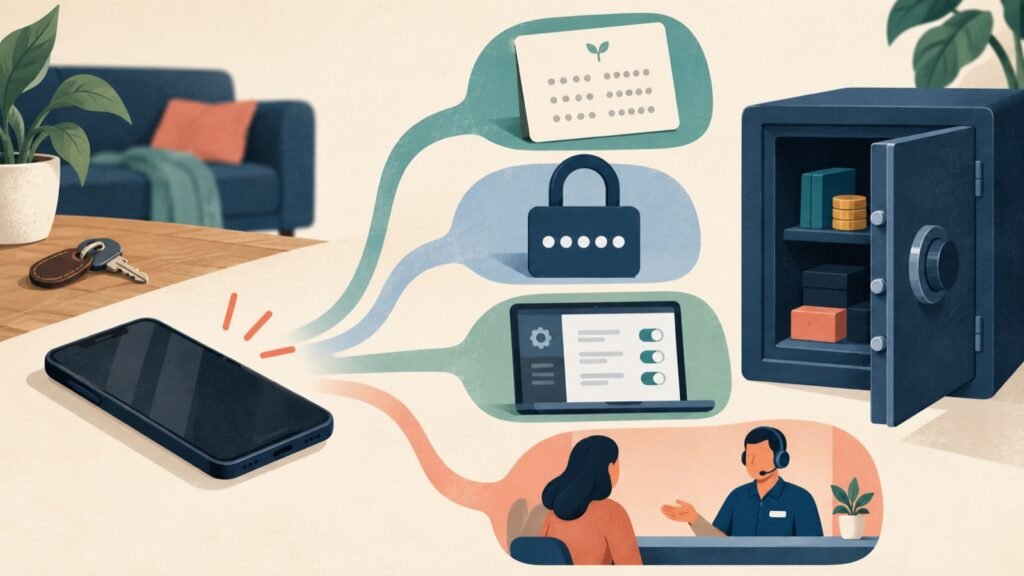
The phone is not where the coins live
For a self-custody Bitcoin wallet, the network records spendable outputs under conditions set by a script. The wallet app helps Leah find those outputs, show a balance and prepare transactions. The authority to spend depends on cryptographic keys and, for some arrangements, multiple signers or conditions. Losing the screen does not erase the network’s record. Losing the means to satisfy the spending conditions can nevertheless make the value inaccessible.
A private key is secret data used in a signing process. It is not the same thing as a password to open an app. A recovery phrase, often called a seed phrase, is a human-readable backup mechanism used by many wallets to recreate seed material from which numerous keys can be derived. The phrase is not a list of all those private keys, and it is not a universal customer-service code.
Think of the wallet as an arrangement with several layers: the network record, the keys that can authorise spending, the method that generated or imported those keys, and the app that displays and uses them. Leah needs to know which layer she actually lost.
First branch: who controlled the keys?
Suppose Leah was using an exchange account and the “wallet” on her phone was the exchange’s app. The provider normally controls the keys for assets held in its custody. Leah’s route back is an account-access and identity process with that provider. Her exchange password or two-factor method is not a private key to an on-chain address, and a self-custody seed phrase from another wallet would not restore an exchange balance. She should use the provider’s verified official support channel and avoid anyone who asks her to disclose recovery secrets.
Now suppose she used a self-custody wallet. The provider cannot simply reset the blockchain’s spending rules for her. The important question becomes how that wallet generated its keys and what was backed up when it was created.
Picture it: recovery depends on the wallet arrangement. On a phone, swipe sideways to read each column.
| Arrangement | What may be needed to regain access | Dangerous assumption |
|---|---|---|
| Custodial exchange account | The provider’s verified account-recovery process | “My self-custody phrase restores this account” |
| Single-seed self-custody wallet | Its correct recovery material and compatible wallet settings | “Any app will find every account automatically” |
| Seed plus separate passphrase | The correct phrase and the exact passphrase, plus compatible settings | “The phrase alone must show the balance” |
| Multisignature wallet | The required number of signing keys and the arrangement’s configuration information | “One signer’s phrase restores the entire wallet” |
| Individually imported key | The relevant key or its own backup, depending on the wallet | “My main wallet phrase includes every key I ever imported” |
Why one phrase can create many keys
In a common deterministic wallet design, one starting seed can be used to derive a branching family of keys. “Deterministic” means the same starting material and derivation choices lead to the same results. BIP-39 describes one widely used way to turn a mnemonic phrase into seed material; BIP-32 describes a method for deriving a tree of keys from a seed. The wallet can use different branches for accounts or addresses without asking Leah to record a new phrase after every transaction.
That convenience has a boundary. A wallet has to know which derivation method, paths and script types to inspect. In Bitcoin, descriptors can carry information about how keys and scripts relate to outputs. A compatible phrase in an app with different assumptions might show an empty balance even while the network still holds spendable outputs under Leah’s original arrangement. “Empty” in a newly installed interface is not, by itself, proof that the assets vanished.
Not every recovery phrase is BIP-39, either. Electrum’s documentation says it does not generate BIP-39 seeds for its own wallets. Similar-looking word lists do not establish that two products use the same scheme. Leah needs the identity and documentation of the wallet that created her backup, not a guess based on the number of words.
A passphrase changes the answer
Some wallets let a user add a separate passphrase to the recovery words. Under BIP-39, the passphrase is part of the conversion into the seed. A different passphrase produces a different valid seed, which can lead to a different wallet. That is why typing the recovery words correctly but omitting or mistyping a passphrase may open an apparently empty wallet rather than display an obvious error.
Trezor’s documentation gives a concrete product example: each different passphrase opens a different wallet, and a passphrase used for a particular wallet cannot simply be recovered by the device maker. This is a statement about that product’s implementation and the underlying BIP-39 behaviour, not a promise that every wallet presents the same screens. Leah should not test guesses on a random website or tell a “recovery agent” what her passphrase might be.
Multisignature needs more than one signer
A multisignature arrangement requires a specified number of signatures from a set of keys. A two-of-three setup, for example, needs two of its three authorised signers to spend. Backing up the phrase for one signer does not magically provide the others. The software may also need to know the wallet’s configuration to identify the relevant outputs and construct the right transaction.
Unchained, a specialist self-custody provider, describes a configuration file for its own multisignature vaults and explains that its recovery plan depends on configuration information and the required keys. That is a useful real-world warning against the “one phrase restores everything” claim, not a universal instruction to download or store such a file. Its own guidance treats the file as sensitive because it can reveal balances and history. The right backup plan must follow the exact wallet’s design and security advice.
The useful preparation happens before a loss
Leah’s best chance of avoiding panic is to know her wallet architecture while she still has access. The inventory is conceptual: which provider or software created the wallet; whether it is custodial or self-custody; what backup format it uses; whether a separate passphrase exists; whether individually imported keys are involved; and, for multisignature, where the official configuration and signer instructions are documented. A record of what exists and where trusted instructions are is not an invitation to put the secrets themselves in an ordinary note, cloud document or message.
She should verify the product’s official recovery guidance and choose a secure backup method appropriate to her circumstances before testing anything. A small, carefully controlled test can expose a missing dependency while recovery is still possible, but the exact steps should come from the wallet maker and trusted security practice, not a generic article. If the architecture is uncertain, stopping to identify it is safer than experimenting with real secrets.
A private key, a seed phrase and a phone are three different things. The network can still record value after the phone is lost. Whether Leah can control that value again depends on the whole arrangement that created and uses the keys. The practical takeaway is not “keep a phrase and relax”; it is “know what your particular wallet requires, protect every secret, and never mistake an empty app screen for a complete diagnosis.”
Evidence · Enhanced
| Claim | Checked sources |
|---|---|
| Mnemonic plus passphrase can derive different wallet seed material |
Bitcoin Improvement Proposals — BIP-39: Mnemonic code for generating deterministic keys (checked 2026-09-25) Trezor — What is a passphrase? (checked 2026-09-25) |
| A deterministic wallet can derive many keys from seed material | Bitcoin Improvement Proposals — BIP-32: Hierarchical Deterministic Wallets (checked 2026-09-25) |
| A seed phrase alone need not restore wallet configuration or multisig access |
Bitcoin Improvement Proposals — BIP-380: Output Script Descriptors General Operation (checked 2026-09-25) Unchained — Download Unchained bitcoin multisig configuration file (checked 2026-09-25) |
| Not every wallet seed phrase follows BIP-39 | Electrum — Seed Version System (checked 2026-09-25) |