Plain answer
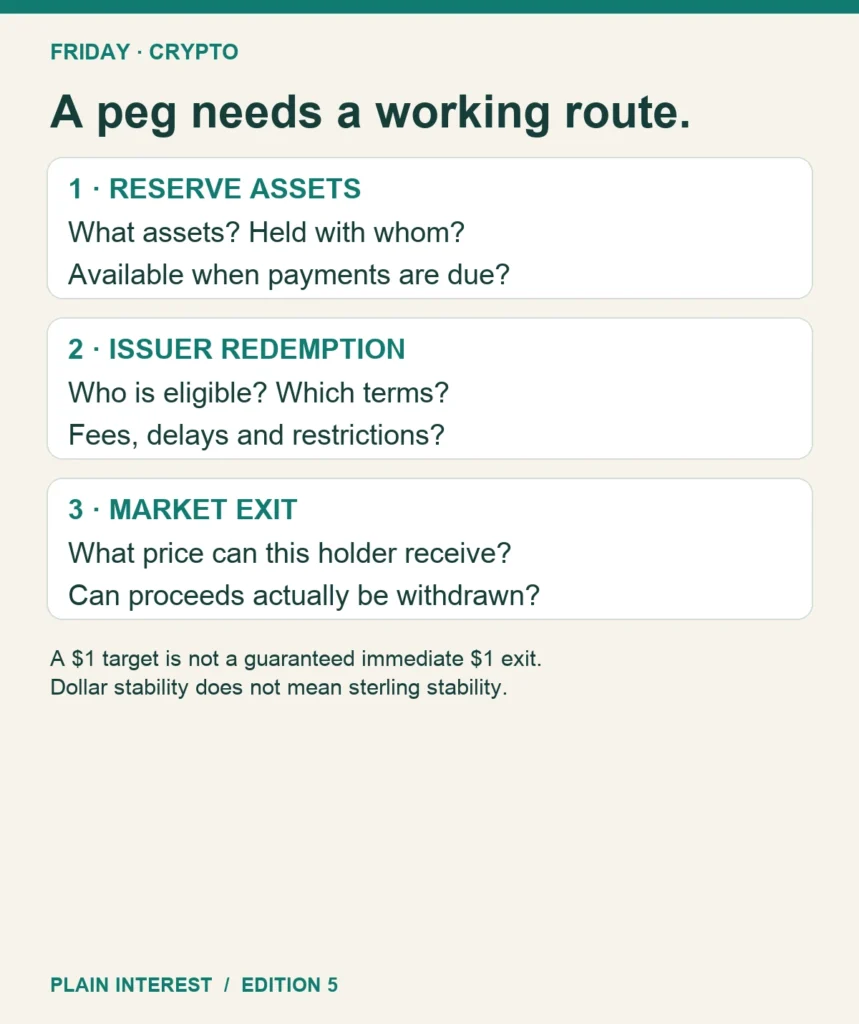
A stablecoin supports a target price through its particular reserves, collateral or incentives and the trading and redemption routes connecting them. Those routes can fail or be unavailable to a particular holder. A dollar peg guarantees neither direct redemption nor a fixed sterling value.
A stablecoin is designed to track a reference value, often one unit of a currency such as the US dollar. Its peg is that target relationship. The word “stable” describes the aim; the mechanism, legal rights and practical exit routes determine how credible the aim is.
Begin with three separate numbers: the target value, the price available in a market, and the amount a particular holder can actually receive on redemption. They can be close together in ordinary conditions and diverge under stress. A dollar peg also says nothing about a fixed value in pounds.
Start with a reserve-backed dollar token
For a simple fictional arrangement, an issuer creates tokens targeting $1 each. Eligible customers pay dollars to the issuer, which issues tokens and holds corresponding reserve assets. Those assets might include bank cash and short-term government securities under the arrangement’s rules.
Redemption reverses the process: an eligible customer returns tokens, the issuer removes them from circulation, and dollars are paid out according to the terms. Reserves give the issuer assets from which to meet redemption requests. The token’s market price, however, is determined by the prices buyers and sellers accept.
This is different from saying each retail holder has a personal insured bank account containing one dollar for every token. The assets, custodian arrangements and claim on them need to be checked. The cryptoasset foundation explains why a token’s rights and practical use matter more than its name alone.
How redemption can pull the price towards the peg
Suppose our fictional token trades at $0.98 while an eligible firm can reliably redeem it for $1. Buying 10,000 tokens costs $9,800. Redeeming them yields $10,000 before costs, leaving a $200 gross difference.
That creates an incentive to buy discounted tokens. Buying demand can lift the market price, while redemption reduces the number of tokens outstanding. Trading between connected prices to capture a difference is called arbitrage. It helps explain how market trading and an issuer’s redemption promise can support each other.
The opposite incentive can work above the peg. If eligible firms can obtain newly issued tokens for $1 and sell them for $1.02, they have a reason to create and sell more supply. That can put downward pressure on the market price.
These are conditional incentives, not an automatic force field. They depend on eligibility, confidence, funding, usable trading venues, processing time and costs. A small price difference may persist because closing it is not worth the expense or risk.
Test the route, not just the arithmetic
Return to the $200 gross difference. Suppose the fictional firm’s total trading, transfer and redemption costs are $70. The apparent remainder is $130. But if redemption is delayed or suspended, that arithmetic no longer describes a completed profit.
If the firm instead has to sell the 10,000 tokens at $0.95, proceeds are $9,500. Against the original $9,800 purchase, that is a $300 loss before costs. A trade that looks attractive only when redemption works is an exposure to that process, not simply a bet on a visible price gap.
A retail holder may face a different route entirely: sell on an exchange, convert the proceeds and withdraw through its banking arrangements. The market bid, venue fees and withdrawal conditions then matter. Knowing that some institution can redeem directly does not establish that you can do so on the same terms.
What the USDC example actually tells a UK reader
USDC provides a real example of a dollar-backed design, not a recommendation. Circle’s terms for holders outside the European Economic Area distinguish customers with Circle Mint accounts from holders without those accounts. Direct redemption with Circle depends on having an eligible account in good standing and satisfying the applicable terms.
The UK is outside the EEA. A UK retail reader should therefore not borrow retail redemption rights from Circle’s separate EEA arrangements and assume they apply. Check the terms covering the holder’s location and account type.
Circle states that USDC is backed by dollar-denominated reserve assets held separately from its corporate funds. Its transparency material describes cash and assets including short-term US government debt and overnight reverse repurchase agreements, which are short-term loans secured on securities. Those are not all the same thing as banknotes waiting in a drawer.
The useful questions are specific: which token and network are supported, who may redeem, through which account, with what fees and restrictions? A token held through an exchange or a bridged representation can introduce another party or technical arrangement between the holder and the original issuer.
Reserves can be adequate on paper but hard to reach
Reserve quality and reserve accessibility are related but different. An asset may have a high stated value yet be difficult to sell quickly, be held with a failed institution, or be subject to legal restrictions. Operational problems can also interrupt the route from a sound asset to a completed payment.
Imagine a fictional issuer with $1 million of reserve assets against one million tokens. If it can immediately use only $100,000 and receives $300,000 of redemption requests, it must access or liquidate other reserves to meet the balance. The headline reserve total does not tell you how quickly that can happen.
If traders fear delays, they may accept a discounted market price for an immediate exit. That discount does not by itself prove the reserves have disappeared. Equally, a statement that total reserves cover tokens does not prove every withdrawal will complete promptly.
Solvency asks whether assets can cover obligations. Liquidity asks whether payments can be made when needed. Keeping those questions separate avoids treating either a temporary disruption or a reserve report as a complete diagnosis.
Read the reserve evidence with its limits attached
A reserve report should identify what was examined, at what date, on what accounting basis and with what assurance. Circle publishes monthly assurance material. Read the actual report’s scope and dates rather than relying solely on a badge saying “backed”.
A report about reserve balances at specified times is not continuous proof of every later balance, every operational process or every holder’s access. An audit of a company’s annual financial statements and an examination of a reserve statement answer different questions. Neither makes a future loss logically impossible.
Ask whether the report covers the precise token and issuing entity you hold. Then compare the reserve evidence with the redemption terms. One describes assets; the other describes the route and conditions for a claim. They should be read together.
Other designs have other weak points
Not every stablecoin follows the same reserve model. Some use cryptoassets as collateral, often requiring collateral worth more than the tokens issued. Falling collateral prices can trigger liquidation, meaning collateral is sold under the system’s rules. Sharp collateral-price falls can put that process under pressure.
Other designs rely more heavily on supply adjustments and incentives involving another token. If confidence in that supporting token collapses, the mechanism can become self-reinforcing in the wrong direction. A promise to exchange one uncertain asset for another is different from access to cash reserves.
These categories also overlap. A short label is not enough to classify every product accurately. Identify the actual backing assets, controls and redemption mechanism rather than assuming two dollar-targeting tokens carry the same risks.
A dollar peg is not a sterling peg
Suppose 1,000 tokens maintain exactly $1 each. When £1 buys $1.25, those $1,000 are worth £800 before fees. If £1 later buys $1.40, the same $1,000 are worth about £714.29. The dollar peg has held throughout, while the sterling value has fallen.
This fictional exchange-rate example isolates currency risk. A depeg, fees or access problems could change the outcome further. “Stable against what?” should therefore be the first question for someone whose eventual spending is in pounds.
Keep today’s UK rules separate from future ones
As checked on 17 September 2026, the FCA says the broader UK cryptoasset regime comes into force on 25 October 2027. Current oversight is more limited, including financial promotions and anti-money-laundering controls. Registration or a compliant promotion should not be read as a guarantee of token value or access.
Do not assume a stablecoin has the protection of an eligible UK bank deposit. A dollar target, a reserve report and a regulator’s name are three different pieces of information. None alone answers whether a particular loss would be compensated.
Before relying on a peg, identify its reference currency, backing, redemption eligibility, market exit and evidence date. Then consider what happens if any one route fails. The exchange-or-wallet lesson supplies the next practical question: who controls access, and what would recovery require?
Evidence · Enhanced
| Claim | Checked sources |
|---|---|
| Reserve-backed issuance and conditional redemption help connect supply and market pricing |
Circle — USDC Terms, updated 12 December 2025 (checked 2026-09-17) Circle — Transparency and Stability (checked 2026-09-17) Bank for International Settlements — The future monetary system (2022): stablecoin mechanisms and fragilities (checked 2026-09-17) |
| Non-EEA Circle terms distinguish eligible Circle Mint account holders from other holders | Circle — USDC Terms, updated 12 December 2025 (checked 2026-09-17) |
| Circle describes segregated dollar-denominated reserve assets including cash and short-term secured/government instruments | Circle — Transparency and Stability (checked 2026-09-17) |
| Reserve assurance and annual financial-statement audits have different scopes |
Circle — Transparency and Stability (checked 2026-09-17) Circle — How to Build Trust: Audits and Attestations (checked 2026-09-17) |
| Crypto collateral and algorithmic arrangements introduce different stabilisation dependencies | Bank for International Settlements — The future monetary system (2022): stablecoin mechanisms and fragilities (checked 2026-09-17) |
| FCA identifies 25 October 2027 as the broader regime start; current oversight is narrower |
Financial Conduct Authority — Crypto firms get guidance on how the new regime applies (checked 2026-09-17) Financial Conduct Authority — FCA sets landmark crypto rules to cement the UK’s place as a global hub (checked 2026-09-17) |