Plain answer
HMRC generally treats exchanging one type of cryptoasset for another as a disposal of the token given up, even when no pounds reach your bank account. A transfer of the same token between wallets you beneficially own is generally different because beneficial ownership has not changed; facts and exceptions still matter.
Swapping one cryptoasset for another can feel like changing investments inside the same digital account. No pounds arrive in the bank, so it is easy to assume that nothing taxable has happened.
HM Revenue & Customs generally sees two different assets, not one continuing pot. Giving up token A for token B is normally a disposal of A and an acquisition of B. The absence of cash does not remove that disposal.
This is one item in a wider risk picture. Plain Interest’s crypto-risk checklist covers custody, scams, volatility, regulation and operational mistakes alongside tax record keeping.
What “disposal” means
For Capital Gains Tax, a disposal is an event in which a person gives up, transfers or otherwise realises an asset in a way recognised by the tax rules. It is broader than a sale for cash.
HMRC’s cryptoassets manual lists selling tokens for money, exchanging one type of token for another, using tokens to pay for goods or services and giving tokens away to another person as examples. Gifts to a spouse or civil partner who is living with the person, and some gifts to charity, have different rules.
A disposal starts a calculation. It does not announce the result. Whether tax is due can depend on allowable costs, gains and losses, exemptions, pooling rules, the person’s circumstances and which tax regime applies. The governing claims in this article were refreshed against HMRC material on 2 September 2026.
Why a token swap has two sides
Suppose a fictional holder swaps token A for token B. HMRC generally treats that as a disposal of A at its sterling market value and an acquisition of B. The sterling value is needed even if the exchange interface shows only token quantities.
That creates two records:
- the disposal proceeds and allowable-cost calculation for token A; and
- the acquisition date, quantity and sterling cost entering the records for token B.
The transaction can therefore create a gain on A while leaving the holder with no cash to meet a later tax bill. If B then falls sharply, that fall does not retroactively erase the earlier disposal. A later allowable loss may have its own treatment and timing.
A fictional no-cash example
Alex, a fictional UK individual, acquired units of token A at an allowable pooled cost of £1,200. Later, Alex exchanges all of them for token B when the A given up has a sterling market value of £1,800. Ignore fees, exemptions and every other transaction for this illustration.
| Record | Illustrative amount | What it represents |
|---|---|---|
| Token A disposal proceeds | £1,800 | Sterling market value of token B received |
| Illustrative allowable cost of A | £1,200 | Simplified pooled cost assumed for the example |
| Illustrative gain before other rules | £600 | £1,800 minus £1,200 |
| Token B acquisition cost | £1,800 | Starting sterling value recorded for B |
Alex receives token B, not £1,800 cash, yet the disposal of A is still measured in sterling. Real calculations can be more involved because HMRC’s share-pooling and same-day or 30-day matching rules may affect allowable cost. The example must not be copied into a return without applying the actual facts.
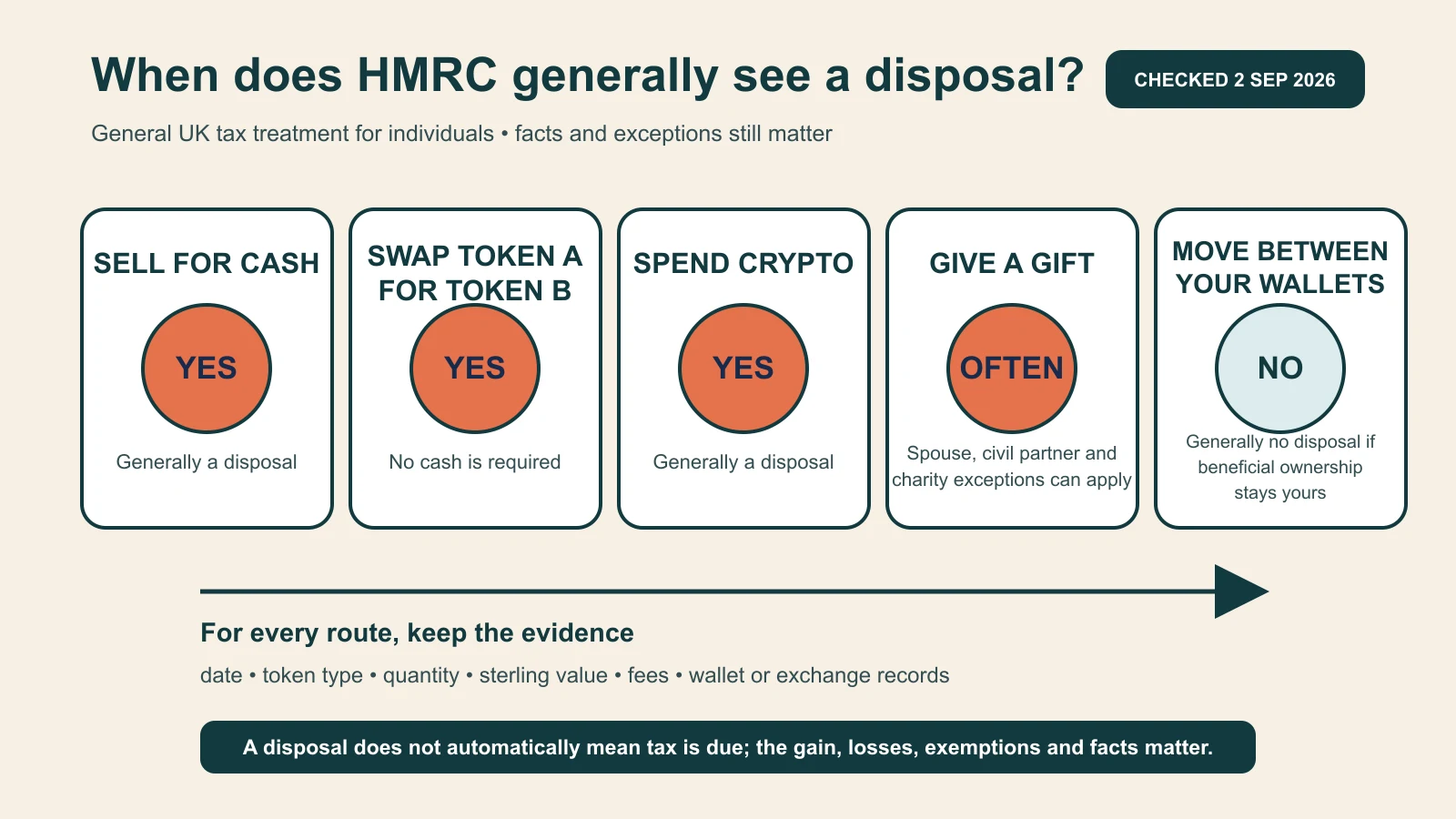
Five common transaction routes
Sell for cash: generally a disposal
Selling tokens for pounds or another currency is the most recognisable disposal. Record the date, asset, quantity, sterling proceeds, relevant fees and evidence supporting the figure.
Swap token A for token B: generally a disposal and acquisition
The token given up is disposed of; the different token received is acquired. An automated conversion, decentralised exchange or “trade” label does not change the basic need to identify both sides and their sterling value.
Spend crypto: generally a disposal
Using tokens to buy a laptop or pay for a service normally disposes of the tokens. The consideration is the sterling value of what is received, subject to the facts and tax rules. Everyday spending can therefore create many small records.
Give a gift: often a disposal, with exceptions
A gift to another person is generally treated as a disposal at market value rather than at zero merely because no payment was received. Transfers between spouses or civil partners living together generally have special no-gain/no-loss treatment, and gifts to charity can qualify for separate rules. Relationship, residence and other conditions matter.
Move the same token between your own wallets: generally not a disposal
If the same person remains the beneficial owner before and after a transfer, moving a token from an exchange account to a self-custody wallet, or between that person’s wallets, generally does not dispose of it. Network fees and arrangements involving another owner, trust, business or wrapper can require separate analysis.
Beneficial ownership is the key distinction
Beneficial ownership means who enjoys the economic ownership of the asset, even if another service holds the private keys or legal title. Changing the wallet address does not by itself change the beneficial owner.
That is why “on-chain movement” and “tax disposal” are not synonyms. A transfer can create several blockchain transactions without changing ownership. Conversely, a swap inside one exchange account can change the beneficially owned asset without sending anything to a bank.
Records should demonstrate the distinction. Keep wallet addresses, transaction hashes and exchange histories that connect both ends of an own-wallet transfer. Without that trail, an outward movement can be harder to explain later.
Fees need their own evidence
HMRC’s manual explains that certain transaction fees may be allowable when calculating gains. The treatment depends on what the fee relates to. In a token swap, an exchange fee may need to be apportioned between the disposal of one asset and acquisition of the other.
Do not assume every network, borrowing, platform or subscription cost is automatically deductible. Record the asset, transaction, amount, sterling value and purpose so the treatment can be assessed rather than reconstructed from a vague monthly total.
A practical record-keeping workflow
- Export exchange histories regularly rather than trusting permanent access.
- Record the date and time, token type, quantity and transaction route.
- Capture the sterling market value and the source used for it.
- Keep fees separately with evidence of what each charge related to.
- Link both sides of swaps and both ends of own-wallet transfers.
- Retain wallet addresses, transaction hashes and relevant statements.
- Do not treat an exchange’s gain report as the tax calculation without checking its assumptions.
HMRC’s public guidance warns that exchange reports may not cover every transaction and are not a substitute for the person’s own records. Multiple platforms, decentralised transactions and wallet transfers make a complete ledger more important, not less.
Reconcile quantities as well as values. If the opening balance, acquisitions, disposals, fees and closing balance do not connect, the missing movement may conceal a swap or transfer that has been classified incorrectly.
When to get personal help
Professional tax advice can be valuable where transaction histories are incomplete, ownership is shared, tokens came from work or a business, decentralised finance creates complex steps, a gift has special facts or the amounts are material. The cost of reconstructing years of activity can exceed the cost of keeping usable evidence now.
Do not extend the simple five-route map to transactions it does not cover. Staking rewards, lending, liquidity pools, wrapped tokens, airdrops, mining, employment income and business activity can raise different income and capital questions. A service calling an action a “transfer” does not settle its tax character; identify what asset and beneficial ownership actually changed.
The useful conclusion
For UK individuals, cash is not the dividing line. Selling, swapping, spending and many gifts can be disposals. Moving the same beneficially owned token between a person’s own wallets is generally different because the owner and asset have not changed.
The practical lesson is to identify the transaction route at the time and keep sterling evidence for both sides. The next useful question is how tax record keeping fits alongside the wider operational, custody and market risks distinctive to cryptoassets.